Online Server Support

  • Subscribe to our RSS feed.
  • Twitter
  • StumbleUpon
  • Reddit
  • Facebook
  • Digg

Friday, 21 December 2007

Brian McCallister on Ning, OpenSocial, and Apache Shindig

Posted on 18:29 by Unknown
By Dion Almaer, Google Developer Programs

When I read an email sent to an Apache Software Foundation mailing list suggesting an open source project for OpenSocial, I wasn't surprised to see it come from Brian McCallister, a prolific open source developer that I met years ago in a former life.

Brian McCallister now works at Ning, the social network outsourcer, and sat down to talk to me about topics revolving around Ning, OpenSocial, and Apache Shindig.

What will you learn from this chat?
  • What Ning is all about
  • Why Ning and Brian think about OpenSocial, and why developers should be interested
  • The parts and pieces of OpenSocial from the standpoint of a developer, and a third party container
  • How Brian thinks that we will get more than just "Write one, learn everywhere"
  • What Apache Shindig is all about
  • How Shindig allows you to do simple local development, which changes the game with respect to your development lifecycle


Read More
Posted in apache, opensocial | No comments

Monday, 17 December 2007

The Roundup: An offline Shindig that is off the Charts!

Posted on 10:54 by Unknown
By Dion Almaer, Google Developer Programs

I just got back from a trip to Belgium that had me speaking at JavaPolis, a conference full of Java and Web folk from Europe and beyond. Google engineers were all over, and we gave talks on Gears, GWT, Google data APIs, Guice, Google Java Collections, and Java language issues. It was capped off with an informal pub meetup where Google and Atlassian took the bill. Remember, they take pride in that Belgian beer.

GWT was in full force at the event. Many people came up to me to discuss their GWT implementations, and a lot of cool APIs and applications have been announced recently. For example, JSTM, the Java Shared Transacted Memory for GWT is a promising new library that gives you a transactional cache that can keep clients in sync. Map this onto Google Gears, and you can get offline caching. The author of the library is taking a lot at that feature right now. We also saw GWT Voices, which gives GWT developers with a cross browser sound API. Finally, Chronoscope showed us that you could take a GWT application, and with a small amount of work get it running on Android. A huge benefit of using the Java programming language across the board.

Speaking of Android, we got to have a nice long chat with Dianne Hackborn and Jason Parks of the Android team about many facets of the platform.

We also got to speak to developers from Zoho, on the release of Zoho Writer that uses Google Gears for full read/write access.

OpenSocial has been chugging away too, and it was exciting to see Apache Shindig, the open source set of components around OpenSocial, get released. This release includes a core gadget container foundation and an open source version of the gmodules.com renderer.

A fun new API was released recently too, which got a lot of buzz in the community. Out of the Zurich office, we saw the Google Charts API, which allows you to create dynamic charts in very short order. You can even integrate the new API with KML for quick data visualization.

The open source side of Google Code has had a busy time too. We released the Google Mac Developer Playground, which is a home for useful open source code produced by the Google Mac team, and any engineers at Google. With this release, Dave MacLachlan announced Statz which has already seen a major upgrade, allowing you to talk to a large swath of services.

On the back of the Google Summer of Code project, the team wanted to keep spreading open source goodness, and announced the Google Highly Open Participation Contest, and have already updated us of its performance. It is outstanding to see so many people coming together to help the myriad of open source communities out there.

To finish up, how about taking a peak at the new Knol effort, or looking at the new developer community calendar, or firing off a video download in the background to watch:
  • Google Gadgets: Experiences of a Top Developer
  • Making the most of maps
  • Zoho Writer: Read Write
  • Upcoming Changes to the JavaScript Language
  • Poker Teaches (for something a little different)

As always, check out the latest tech talks, subscribe to the Google Developer Podcast and visit the Google Code YouTube channel.
Read More
Posted in weekly roundup | No comments

Our new Developer Community Calendar: View it, Map it, Add to it!

Posted on 08:11 by Unknown
By Pamela Fox, Google Developer Programs

I was scheduling a trip to New York City last month to visit some friends and thought, "Well, it'd be nice to take in a conference or two." I proceeded to search online for hours -- including queries like "new york city ajax," "conferences new york," "user group new york" -- and came up basically empty handed. Frustrated, I cornered my co-worker Austin Chau, and we did what us geeks tend to do when we want something: we hacked it up ourselves!

Google's 'Developer Events Calendar' has always listed Google-sponsored and/or Google-attended events, but today we're launching a second calendar for the developer community at large. You can view both calendars side-by-side in either calendar view or map view, and with a Google Calendar account, you can add your own meetup to the list. (If you're keen on the project's technical specs, we'll be writing about the code itself shortly, so check back soon for an article and source links.)

We hope you find the calendars useful, and we look forward to your feedback. Try it out now: add your upcoming conference, user group, or party. (Yes, we developers know how to party. If you don't know how, I'll graciously volunteer to show you).
Read More
Posted in community, events | No comments

Monday, 10 December 2007

Keeping OpenSSL up-to-date

Posted on 18:12 by Unknown
By Steve Marquess, Open Source Software Institute

OpenSSL is perhaps the most widely used of all cryptographic libraries, both in the open source world and by commercial enterprises. The OpenSSL team is often approached by such enterprises seeking assistance with specific problems or features of particular interest to that enterprise. Less often they are approached by a sponsor with a technical need and the vision to address that need in a way that benefits the open source community as a whole.

OSSI has had a long association with OpenSSL, beginning with work over a five year period on the groundbreaking FIPS 140-2 validation of an OpenSSL derived crypto library (implemented largely by Googler Ben Laurie) and continuing with additional validations currently underway with extensive improvements by Dr. Stephen Henson and others. We were pleased to help facilitate Google's sponsorship of RFC4507 support to OpenSSL.

RFC 4507, also known as “stateless session resumption,” is a relatively new draft standard for a mechanism that enables a secure web (TLS) server to resume sessions without explicitly preserving per-client session state. The TLS server encapsulates the session state into a ticket that is preserved in encrypted form and subsequently provided to a client. That client can then resume the previous session using the information in that ticket, avoiding the need for the full TLS negotiation.

This mechanism may be used with any TLS ciphersuite. It makes use of TLS extensions defined in RFC4366 and defines a new TLS message type.

Stateless session resumption is of particular value in the following situations:

  1. For servers that handle a large volume of transactions from many users

  2. For servers that must cache sessions for a long time

  3. For load balancing requests across servers

  4. For embedded servers with little memory


As an added bonus, RFC4366 support includes the Server Name Indication extension, which allows browsers to specify a server name when connecting to an SSL host. This means that SSL hosts can finally use name-based virtual hosting instead of burning an IP address per host.

The implementation in OpenSSL and the interoperability testing were performed by Steve Henson. This support is available in both the current 0.9.8 product branch and in the development trunk (0.9.9).
Read More
Posted in cryptography, open source, openssl, security | No comments

Friday, 7 December 2007

Open Source in Zurich with vigor and Vim

Posted on 10:25 by Unknown
By Leslie Hawthorn, Open Source Team

Looking for a cool place to hack with like-minded colleagues? Going to be in or around Zurich on December 13th? If so, please join us for our inaugural Open Source Jam held at Google Switzerland. We'll provide the hacking lounge, Wi-Fi, pizza, beer and the creator of the Vim text editor, Bram Moolenaar. You supply your laptop, good ideas and community spirit.

You can find full details and information on how to register in our Open Source Jam Zurich Google Group. If you haven't already done so, please join the group and let us know your thoughts. And if you happen to attend the event, post a comment and let us know how it went.
Read More
Posted in open source, ossjam, Vim, zurich | No comments

Thursday, 6 December 2007

In just seven days

Posted on 17:00 by Unknown
By Leslie Hawthorn, Open Source Team

We announced the Google Highly Open Participation Contest a little over a week ago, and the response has been phenomenal. We already have over 350 student contributors, and the participating organizations have let us know that they're overwhelmed by all the great contributions they've received from their contestants. We're delighted to bring you this video status update, with an extra treat: Guido van Rossum, the creator of Python, stopped in to tell us a little bit more about the Python Software Foundation's participation in the contest.


We always love to hear from you, so feel free to contribute some task ideas and join the contest discussion list.
Read More
Posted in ghop, open source | No comments

Embed charts in webpages with one of our simplest APIs yet

Posted on 08:20 by Unknown
By Steve Crossan, Chart API Team

Today we're launching the Google Chart API, a really simple tool for creating charts and graphs that are perfect for websites.

Let's get straight in with an example. This URL:

http://chart.apis.google.com/chart?cht=p3&chd=s:hW&chs=250x100&chl=Hello|World

Creates this image:


That's it - no state, no calls, just send your data in an http request and get a png image graph back. Embed the request in an img tag and you're done. We currently support line charts, bar charts, pie charts, scatter plots, and sparklines.

We actually built this originally to use internally - we use it on Google Video and Google Finance for example. It seemed like it would be a good thing to open up to other users too. You can find out all about it at on the Google Chart API homepage and there's a Google Chart API group for questions and support.

The Google Chart API started out as a 20% time project here in Zurich, and we're really happy to be launching it to the world today. Let the charting begin!
Read More
Posted in apis. charts | No comments

Wednesday, 5 December 2007

Google Developer Podcast Episode Twelve: Android with Dianne Hackborn and Jason Parks

Posted on 09:30 by Unknown
By Dion Almaer, Google Developer Programs

As soon as Android and the Open Handset Alliance was out in the wild, we were chomping at the bit to talk with some of the people behind the platform to discuss the developer-related information.

Using iTunes?


We were lucky enough to get some time from Dianne Hackborn and Jason Parks, who have been doing this work for a long time. They used to be at Be, and PalmSource, and you will hear how that experience has come through to Android. In fact, you will see how the Android team has engineers from many other platforms (Linux, Danger, and Windows Mobile).

Dick Wall himself is an advocate on Android, and you can hear how excited he is to talk about this!

What will you learn on this podcast?
  • Some history behind the project
  • The high level architecture of Android. For example, how Linux processes handle the VM and manage security (the VM doesn't handle it)
  • Details on the Dalvik VM and how it is optimized for small devices
  • The architecture: From Intents to Views to Permissions and more
  • How XML is slow, but the tools convert the XML to a nicer format for you
  • The tooling and steps for building an application on Android
  • How so many objects have a URL, and how the environment is like a mini-SOA (Services across processes instead of across the network)
  • Thoughts on how you program for small devices, and things to watch out for if you move from the desktop
  • The control, or lack of control that you have over the application lifecycle
  • "Everything you do drains the battery"
  • The thread story: they exist, you don't have to deal with them if you don't want too, and the UI
  • Using XMPP for messaging

You can download the episode directly, or subscribe to the show (click here for iTunes one-click subscribe).

Want to learn more about Android? Read the book or watch the movie depending on how you are feeling!
Read More
Posted in android, podcast | No comments

Friday, 30 November 2007

Google Data Ideathon

Posted on 14:47 by Unknown
By Stephanie Liu, Google Data APIs Team

The Google Data team is holding a local event for developers Thursday, December 13th, 5:00pm-10:30pm at the Googleplex (Mountain View, CA). It'll be part hackathon, part unconference, part user group, part food, and part fabulous prizes.

Besides a short kick-off session, everything else will be up to you. We'll provide the wi-fi, power and food, and you can utilize the time however you want -- whether it's to pick the brain of someone on the GData team, meet other local developers, hack away on your current project, sit in on impromptu sessions about things like GData + Gears and GME, or hold your own lightning talk about the project you're working on.

Head over to the GData blog for the full announcement and the event page to RSVP and for more info.

Hope to see you there!
Read More
Posted in gdata | No comments

Thursday, 29 November 2007

Google Gadgets going cross-platform

Posted on 09:00 by Unknown
By Mike Pinkerton, Software Engineer

For about two years now, people have been writing gadgets for Google Desktop on
Windows and for iGoogle on the web. Today, with the announcement of Google
Gadgets for Mac OS X, Google Desktop users on the Mac can now run the same
Windows and web-based gadgets in Apple's Dashboard with zero (or very few)
changes. Check it out for yourself.

Google Gadgets for the Mac uses WebKit's JavaScript engine inside Dashboard, so
the majority of gadgets just work if they're written properly. The rest can be
fixed by following a few guidelines:
  • Use JavaScript, not JScript
    • WebKit is case-sensitive, JScript is not, which can lead to problems if you assume can you do things like interchange SetTimeOut() and setTimeout().
    • Avoid JScript-only features like collections and ActiveX.
    • Avoid IE-specific DOM extensions, just as if you were writing a multi-browser web application.
  • Avoid Windows-specific APIs
    • You shouldn't assume ActiveX or certain DLLs are available. Neither WebKit nor Mac OS X supports ActiveX, so these gadgets must be rewritten.
    • Avoid Windows-only APIs such as Google Talk. These APIs are not (yet) available on Mac OS X.
  • Understand how Dashboard is different
    • The Dashboard environment is very different from a web page or the Desktop sidebar on Windows in that it comes and goes as the user activates it. Don't rely on your gadget always being visible. Your gadget won't run or update when Dashboard isn't in the foreground.
    • Don't rely on access to the file system. The security model for Dashboard doesn't allow arbitrary file access to the hard disk, although your gadget does have access to files in its own archive. Things like file pickers won't work. Note that while restricted file system access is a departure from how gadgets work on Windows, it's consistent with Dashboard's security model and the behavior of other widgets developed for Mac OS X.

For more details, see Writing a Cross-Platform Gadget, part of the Desktop Gadget API documentation.

If you're interested in developing your own gadget, visit the Gadgets API homepage. If you're already a gadget developer, download the beta today to test your gadget and ensure that it works correctly.
Read More
Posted in gadgets, mac | No comments

Wednesday, 28 November 2007

Chronoscope: 2 + 2 = 5 with GWT and Android

Posted on 12:07 by Unknown
By Dion Almaer, Google Developer Programs

Timepedia has released Chronoscope, an open source charting and visualization library, built using GWT.

It features:
  • Canvas abstraction for drawing vector graphs
  • Graph Style Sheets abstraction for configuring the look-and-feel of charts
  • Scalable multiresolution rendering supporting up to tens of thousands of points
  • Zoom and pan at interactive frame rates, from centuries to milliseconds
  • Auto-ranging, auto-layout of chart axes and ticks.
  • Auto-legend, and mini-chart Overview
  • Add pushpin markers, domain and range markers, and overlays like Google Maps
  • Bookmarkable chart state, works with Back button
  • JS interopability. GWT API can be used by pure Javascript programmers
  • Microformat support. Charts can be configured without programming.
  • Server-side Font assistance. Render rotated text.
  • Portable, Chronoscope is not tied to GWT, can be used to render from servlets, applets, or other environments.

What is particularly interesting is how the Chronoscope team was able to take their existing Java source code, add 8 hours of Android exploration, and ended up with the same charting and visualization library that works on Android using their graphics support.

This is one area that GWT truly shines. The fact that you write your code in the Java programming language means that you can reuse it in other places where Java runs. Being able to write one application and quickly have it run on Android and the iPhone is pretty compelling.

Here you can see it running:

Read More
Posted in android, chronoscope, gwt | No comments

Tuesday, 27 November 2007

It's here: the Google Highly Open Participation Contest

Posted on 19:10 by Unknown
By Leslie Hawthorn, Open Source Team

The Google Summer of Code program has been a joint labor of love between Google and the open source community for the past three years, and the results have been spectacular: hundreds of college students have been introduced to open source software, thousands of people across the globe have begun development together and millions of lines of open code have been produced, 4 million last year alone. We've been particularly proud of this program and how much it has helped the community and we've spent a lot of time thinking about ways we can continue helping open source projects find even more contributors. Today, we're pleased to announce the Google Highly Open Participation Contest, our new effort to get pre-university students involved in all aspects of open source development, from fixing bugs to writing documentation and doing user experience research.

While we're very excited about many aspects of the contest, the best part is that everyone can participate. Contestants must meet the eligibility requirements, but anyone interested in helping out can simply suggest a task to be included in the contest. Our contestants have a chance to win t-shirts, cash prizes, and a visit the Googleplex for a day of technical talks, delicious food and a photo with our very own Stan T. Rex.

Want to learn more? Check out the contest FAQs and tell your favorite pre-college students to pick a task or two to complete. You can always visit our discussion group to get help or share your thoughts.

Update: Fixed the broken links.
Read More
Posted in ghop, google summer of code, open source, soc, student programs | No comments

ZXing 1d/2d Barcode decoding source code released

Posted on 11:34 by Unknown
By Sean Owen, Google Print Ads Team

Recently in the New York Times, we placed a small graphic as part of a Google Print Ad. You aren't looking at one of those eye focus games (It's a sailboat! Or a shark!) but a two-dimensional barcode. Those of us who already know what it is pulled out our phones and "clicked" it with the camera, and were connected to the advertiser's web site. "Wha?", you say? See http://www.google.com/printads/barcode. While this kind of thing has been a common sight in Asia for years, this ad is one of many signs that the technology is arriving in Europe and North America.

But Advertising is only part of the story here. Engineering is also involved and we want to improve the quality and availability of barcode reader software available to developers and end users. So today I would like to announce the "ZXing" (from: "zebra crossing") project, an open-source, Java, multi-format 1D/2D barcode reader which can be built into a reader application for Java and Java ME -- and later, Android.

This project began as a 20% project and is not yet complete, so opening it up is a bit of an experiment. It's not yet the Best Barcode Reader Ever, but it's looking pretty good. For now we want to find those those who can make use of and help improve what's here, so that those good ideas are shared to all developers and everybody wins.

Developers can find the ZXing project on Google Code, and we hope you'll join us on our Google Group and tell us about what you like and don't like about the code.
Read More
Posted in 20% project, barcodes, google code project hosting, open source, ZXing | No comments

Friday, 16 November 2007

Weekly Google Code Roundup: The Androids are openly social

Posted on 11:50 by Unknown
By Dion Almaer, Google Developer Programs

I just have to take a breath as I start this posting. The last couple of weeks have been a real trip as we first announced OpenSocial and then Android, both announcements that have drawn a lot of interest.

Let's start with Android. We started out announcing the Open Handset Alliance and made sure people realise that this effort is bigger than a Google Phone. It is a mobile platform, with many phones to come! After some of the initial surprise we released the part that you, as a developer, care about: Android SDK.

We have been astonished at the response. We now have over three and a half thousand messages on the Google Group with four thousand members. The discussion has been all over the map, from initial Eclipse setup, to discussing the sample code, to working on how to write native applications on the platform.

We have plenty of material for you to absorb, but a great way to start it:
  • Take a look at the applications and UI that is already out there
  • Let Mike walk you through the platform
  • Watch Dan build an application

We are so excited to see the developer interest, and can't wait to see the applications that win money from the $10M prize pool.

Finally, to show how open platforms propel themselves, we got to release open drivers for the QualcommMSM7K.

It's the social

Just before the Android launch, we unveiled the group that worked together to create the OpenSocial APIs.

We have only just begun here, and the current API is a baby 0.5 release, but it is contagious to see the container and social developers work together. Patrick Chanezon sat down and chatted with us about the new APIs and the Campfire One announcement shows you a lot.

To enable developers to get containers going quickly we have put out an opensource container sample and have also seen the beginnings of Apache Shindig, another potential container.

The container partners are coming online quickly. We have already seen the hi5, Ning, and Plaxo sandboxes go live and more are coming.

To get a feel for the various containers and applications that have already been developed, check out video interviews that tell the story nicely.

And in other news...

Android and OpenSocial are not the only bits of news out there. Let's have a quick roundup:

Gmail got a backend facelift and we announced a new email migration API.

There are a couple of fun new open source projects announced: AxsJAX aims to make accessible Ajax applications more possible, and nsscache is an open source named services system.

We put together a nice piece on a spider's view of Web 2.0 which discusses SEO principles and how Web 2.0 practices affect, or do not affect them. What about Web -1.0? That is discussed in this great tech talk on the Web that wasn't. A nice history lesson.

I got to host my first tech talk at Google. I was lucky enough to pull in Steve Souders, Chief Performance Yahoo!, to discuss High Performance Web Sites and YSlow. If you want to make sure your sites run well, check out his core principles.

Oh, and one other thing. The Google Code team did a huge amount of work in revamping Google Code which coincided with the major launches. We believe that the site is a lot cleaner now, and gives us a base to work on as we move forward to do a better job at serving all developers out there. Thanks for joining us so far.

As always, check out the latest tech talks, subscribe to the Google Developer Podcast and visit the Google Code YouTube channel.
Read More
Posted in weekly roundup | No comments

Thursday, 15 November 2007

Each and every email

Posted on 14:52 by Unknown
By Ryan Propper, Google Apps Team

With hundreds (if not thousands) of popular email clients and mail servers out there, importing email into another service can be challenge, especially when you consider the troves of old email most people save. To ease this pain, we created the Google Apps Email Migration API.

This new API is available in Google Apps Premier, Partner, and Education Editions, and you can use it to migrate your existing email from anywhere into Google Apps. Let's say, for example, you want to import email from your Obscurix Email Server v2.0001715. Just write some parsing code and use our simple API to upload that email into the desired mailbox. For convenience, you can authenticate to the API not only as the end user of the destination mailbox, but also as a Google Apps administrator, and target any mailbox in the domain. This API uses the Google data API protocol, which means there are a host of client libraries to make importing even easier.

LimitNone (one of our Enterprise Professional partners) has already built a migration utility that works with calendars, email and contacts.

For more info, check out the Google Enterprise Blog, or just dive right into the developer's guide. And please, let us know what you think!
Read More
Posted in apis, email, google apps for your domain, google data apis | No comments

Tuesday, 13 November 2007

Introducing AxsJAX -- Access-Enabling AJAX

Posted on 10:14 by Unknown
Posted by Charles L. Chen and T.V Raman

As the developer behind Fire Vox I've always wanted to make AJAX web applications truly usable for the blind and visually impaired. The challenge is that these users have to deal with a much higher learning curve than sighted users. Instead of simply learning the controls for a web application, they have to also learn how to get their assistive technology of choice to go to the interesting parts of that application to find out what is currently there.

When I started as a Noogler, I was extraordinarily impressed with the tools that T.V. Raman had built into Emacspeak for efficiently performing specific tasks. An insight that I gained from watching him use Emacspeak is that the application should just say the right thing in response to user actions; users should not have to do an action in the application and then use their assistive technology to go hunting around the screen to figure out what happened.

In my first week at Google, I discovered Google Reader a highly optimized feed reader with very good keyboard support. For my starter project at Google, I decided to access-enable this application using W3C ARIA. Using Greasemonkey, I could inject JavaScript code to add the needed ARIA bits to make Google Reader say the right things at the right time.

Connecting The Dots

Based on the experience of access-enabling Reader, we have now refactored the code to come up with a common JavaScript framework for enhancing the accessibility of AJAX applications. This framework is called AxsJAX, and it was refined in the process of access-enabling Web Search.

We're now excited to open-source this framework since we believe that there is nothing Google-specific in the techniques we have implemented. We invite the Web developer community to help us collectively define a robust framework for rapid prototyping of accessibility enhancements to Web 2.0 applications.

The ability to rapidly prototype end-user interaction has led to an explosion in the number of AJAX applications; until now, visually impaired users have been left behind in this process. We hope that the AxsJAX framework encourages the Web community to bring the power of Web 2.0 development to solving the problem of accessing rich Web interaction in an eyes-free environment.
Read More
Posted in accessibility, ajax, axsjax, firevox, open source, reader | No comments

Monday, 12 November 2007

Android SDK, MSM7K kernel patches and blog now available

Posted on 08:28 by Unknown
Posted by: Chris DiBona, Open Source Programs Manager


Many of those subscribed to this blog have heard our recent announcement about the Open Handset Alliance, and we thought we'd bring everyone up to date. Today, the team released an early look at the Android SDK for developers interested in building applications for Android.

By the way, we've released more than just the SDK. Those of you who follow the development of the Linux kernel on ARM may have seen that we released our initial patches that provide kernel support for the QualcommMSM7K. This release means that support in the Linux kernel is now available for the on board serial, i2c, timer, NAND flash controller, MDP/MDDI framebuffer, gpio controller, and high speed USB client controller. This code also provides access to the baseband features of the chip. The announcement to the kernel developer community can be found on the ARM Linux mailing list. Like all proper Linux kernel code, these patches were released under v2 of the GNU GPL. Stay tuned for more open source related details.

We're really excited about all of these developments and can't wait to see what results. To help get things started, we've also announced the Android Developer Challenge, a $10 million challenge to reward developers for working with the platform. Head over the Android Developers blog to find out more about this exciting mobile platform.
Read More
Posted in android, oha, phone | No comments

Monday, 5 November 2007

nsscache: open source named services system release

Posted on 23:14 by Unknown
By Jamie Wilkinson and V Hoffman, Systems Administrators

Remember remember the fifth of november, especially if you have to manage unix Named Services (NSS) on a lot of workstations! We're releasing a small python utility, called nsscache, that is used to cache remote NSS maps locally on a given host. Combined with cron, it provides a simple and effective way to remove a critical network dependency from your hosts and potentially speed things up a bit.

You'd be surprised how upset a system can get with a slow, unresponsive, or missing NSS.

This initial release supports pulling passwd, shadow, and group maps from an RFC 2307 LDAP schema and storing them in either nssdb or flat text files. In a wee bit, we'll also release support for netgroup and automount maps as well. The utility is fairly plug and play; our hope is that folks who use it with other data sources (sql databases, soap, etc) and possibly other data stores will extend our codebase and share their extensions with the rest of the open source community.

Why you may be interested?

As soon as you have more than one machine in your network, you want to share usernames between those systems. Linux administrators have been brought up on the convention of LDAP or NIS as a directory service, and /etc/nsswitch.conf, nss_ldap.so, and nscd to manage their nameservice lookups.

Even small networks will have experienced intermittent name lookup failures, such as a mail receiver sometimes returning "User not found" on a mailbox destination because of a slow socket over a congested network, or erratic cache behaviour by nscd. To combat this problem, we have separated the network from the NSS lookup codepath, instead using an asynchronous cron job and a glorified script, improving the speed and reliability of NSS lookups.

We'll be giving a small presentation about our motivations and experiences at the upcoming linux.conf.au event in Melbourne Australia, if you happen to be down under in February!
Read More
Posted in named, nss, open source, unix | No comments

Friday, 2 November 2007

Google Developer Podcast Episode Eleven: OpenSocial with Patrick Chanezon

Posted on 15:21 by Unknown
By Dion Almaer, Google Developer Programs

The announcement of the OpenSocial project is really exciting, so I was really glad to drag Patrick away from his work to take some time to chat with me about it.

Using iTunes?


Patrick is easy to talk too, and I think that comes across in the interview itself. There has been a lot of pre-release speculation on what OpenSocial really is, and the press has put out wildly different ideas over the last couple of weeks. Patrick lays out the facts of the announcement.

He covers a lot, including:
  • What has actually been released
  • What OpenSocial isn't
  • Details on the various APIs:
    • People Data API: You can get access to owners and viewers, and their friends
    • Persistence Data API: Store simple hash table data for the users using your application
    • Activities Data API: Like the Facebook News feed
  • What it means to be an OpenSocial "container"
  • Fun social apps that Patrick has seen developed by the trusted testers
Sit back and listen to Patrick's dulcet French tones as he takes you through all things OpenSocial.

You can download the episode directly, or subscribe to the show (click here for iTunes one-click subscribe).

Also, check out video from the Campfire One event and interviews with a subset of the partners involved in the OpenSocial launch. Having a large number of application developers and container vendors show what they have already done gives you a glimpse to the future.

Now I want to record the next podcast by the fire.
Read More
Posted in opensocial, podcast | No comments

Thursday, 1 November 2007

Can I please have s'mores

Posted on 22:05 by Unknown
By Andrew Bowers, Google Developer Programs

When Vic asked me to organize a campfire on campus, at first I thought he was joking. But when he kept asking how big the fire was going to be, I quickly realized he wasn't. Thus Campfire One was lit.

Campfire One is a means to share product announcements with lots of people in a way which keeps pace with Google's release cycle. We invite a few people to campus and record our news for the web. There's no Campfire Two, just another Campfire One in the future. The 'One' signals that we've flipped the bit on something we think is worth sharing.

Tonight at Campfire One we were very excited to introduce OpenSocial, a common set of APIs for building social applications across the web. With OpenSocial, developers have less to learn in order to build for multiple websites. There are a number of companies already working on the OpenSocial APIs, including those who presented with us tonight: MySpace, Ning, hi5, iLike, FotoFlexer, RockYou, Slide, Viadeo, Flixster, LinkedIn, Ning, Salesforce, Theikos, and Virtual Tourist. Watch Campfire One from earlier this evening:


By the way, did you know that oak on a campfire is supposed to smoke less than fir? I don't think some of our presenters believe it. You might say we had a bit of a real 'smoke test' before rolling the cameras.
Read More
Posted in | No comments

My How We've Grown

Posted on 09:00 by Unknown
By DeWitt Clinton, Google Developer Programs

In 2005 we launched Google Code to provide a home for our developer and open source programs. Two years, dozens of new products and new programs, and one major redesign later, Google Code is bigger and more dynamic than ever. With today's relaunch we've added a new search auto-complete feature (to help you find your favorite products with a keystroke or two in the search box), an expanded and improved search results page, a cleaner and more comprehensive site directory, new blog and group gadgets, and a simplified and unified look and feel for product documentation.

To get a sense of how far things have come you can take a look at the first version of Google Code, back when the whole site almost fit on one page. Today we have thousands and thousands of pages of content on Google Code, and we've added the new site directory and new search features to help you navigate them.

One of the most exciting things about the redesign is that everything you see here was built using technology and APIs that are available to everyone. The pages we're serving don't rely on any secret back-end tricks; the site is built on plain HTML, JavaScript and CSS, each using our public APIs. In fact, all of the techniques used on Google Code can be duplicated on your own site.

For example, the search results pages use a combination of the AJAX Search API and Custom Search Engines. The homepage gadgets use the AJAX Feed API and Google Reader feeds. The videos are powered by the YouTube API, the blogs by the Blogger API, the events powered by the Google Calendar API, the metrics by Google Analytics, the forums by Google Groups, etc., etc.. And we're pleased to use jQuery, the wonderful open source JavaScript library (not ours, we're just fans), to help power each page. Stay tuned -- over the upcoming weeks we'll offer detailed articles and tutorials about how we built the various parts of Google Code using open technologies.

But the best thing about Google Code hasn't changed: And that's you, the developer, our never-ending source of inspiration. Your projects provide countless examples for the Featured Projects feeds, your words and wisdom power the developer groups, and your accomplishments and ideas never cease to amaze us with the possibilities and potential for a better web. This redesign was for you, and I want to personally thank all of you for being such an integral part of Google Code. Together we're capable of doing something very special.

Please join us on the Google Code Blog, (where we'll be enabling comments for this and future posts), and let us know where you're headed and how we can help you get there.
Read More
Posted in google code | No comments

Friday, 26 October 2007

Weekly Google Code Roundup: Leopard day, JavaScript fun, and the open source world.

Posted on 14:23 by Unknown
By Dion Almaer, Google Developer Team

It's Leopard day. I am really excited to get home to install the new version of OS X. It isn't actually the new operating system itself that excites me, it is the new applications that I know have been waiting for this release to be able to see the light of day. Our own Google Mac team has announced an update for Leopard, so update Google Desktop before you change your strips for spots. When you setup the new Mail.app, consider enabling IMAP in Gmail and using both (I have been looking forward to IMAP support for a long time)!

I was really excited to see our Blogger GData JavaScript client library release. I am particularly proud of the examples that came along with the release as they really show you some of our ideas and give you good starting points for your own secure mashups.

If you want to test GData endpoints, there is help for doing some testing with cURL which we documented for you.

We got to hear to some of the teams too. Bruce Johnson and Joel Webber, members of the Google Web Toolkit team, had a nice interview with Pearson before the upcoming conference on GWT.

Paul McDonald and Rich Burdon of the Google Mashup Editor Team also discussed the nuances of the GME product and where it is heading.

In the Google Maps world Pamela played with clickable Polygons and used the ability to play a game. Also, if you are a Flash-y kind of guy, you can do more with KML and Flash.

We hosted a lot of open source meetings such as:

  • Google Hosts CIFS Workshop
  • Updates from the I Free Software Forum
  • KDE 4.0 Release Party at Google HQ


For those that like to search across open source code, we have a new ability to tell us more about your code via the integration of Google Code Search and Sitemaps.

Fancy some video? We had some great tech talks on campus including:

  • Randall Schwartz on Git
  • An internal look at VMware Fusion
  • Internet Security Keynote Google VP Vint Cerf


As always, check out the latest tech talks, subscribe to the Google Developer Podcast and visit the Google Code YouTube channel.

I am now heading out to get Leopard roaring, but a couple of final points. The new Google Finance Gadgets are interesting, and take a look at how our developer team lives in a Mario World.
Read More
Posted in weekly roundup | No comments

Thursday, 25 October 2007

Podcast with Bruce Johnson and Joel Webber

Posted on 16:20 by Unknown
By Jimmy Caputo, Product Marketing

Last week the folks at Pearson Education sat down with Bruce Johnson and Joel Webber to discuss the creation of Google Web Toolkit and Pearson's December conference Voices that Matter: Google Web Toolkit. Listen to the podcasts to hear Bruce and Joel explain the history of GWT and the challenges of building a cross-browser Java-to-Javascript compiler. They also talk about the sessions that they are most looking forward to attending at the conference, and their upcoming book on GWT. Thanks to Bruce and Joel for sharing their thoughts and to Barbara and Greg at Pearson for putting this together.

Registration for the Pearson conference is still open, but be sure to register before October 27th (this Saturday) to receive the early bird pricing discount. You can review the complete list of sessions and speakers on the conference website.
Read More
Posted in conferences, google web toolkit, podcast | No comments

Wednesday, 24 October 2007

Google Hosts CIFS Workshop

Posted on 16:15 by Unknown
By Jeremy Allison, Open Source Team and Samba Core Developer

Around sixty developers from over twenty different companies converged on Google's Mountain View Campus at the end of September to sample the free food. Oh yes, and also to test their implementations of the CIFS network protocol for interoperability.

CIFS, the Common Internet File System (that's Windows Networking to you and me), is the file sharing protocol build into all Windows versions, and also MacOS X, Linux, HPUX and now Solaris clients. Samba is the best known Free Software implementation of CIFS, and most of the Samba Team were there to help improve Samba3 and Samba4's interoperability along with the other CIFS vendors.

Over the three days much code was written, much beer was drunk, and the air was turned blue with cursing when bugs were found! As the Samba Team were mentoring several Google Summer of CodeTM students, we also got to record a podcast about our experiences participating in the program over the past three years.

Thanks to Google for hosting the event and setting up the gigabit networking required. The endless coffee supply was also essential when dealing with network protocol problems.

The best summary of the success of our testing occurred on the final day of the event, when a sad and frustrated CIFS client programmer wrote the following on our testing notes whiteboard:

"the server *hates* me :-) :-)"

It was great to see everyone coming together, even people from competing companies, to help fix problems with everyone's implementations of CIFS. Look for the resulting improvements in new versions of products and future releases of Samba.


The Samba Team takes a break during the CIFS Workshop.

(Photo Credit: Leslie Hawthorn)
Read More
Posted in cifs, hpux, linux, open source, osx, podcast, samba, solaris | No comments

Tuesday, 23 October 2007

Updates from the I Free Software Forum

Posted on 16:43 by Unknown
Post by Fernanda Weiden, Systems Administration Team

I recently traveled to the I Free Software Forum in Lisbon, Portugal, where I gave two talks. The first was on load balancing and the second focused on "Google e o Software Livre" (Google and Free Software). The main organizer of the conference was Ralf Braga, an old friend of mine from Brazil, who moved to Lisbon few months ago.

Both of the talks were well attended, which was great. During my load balancing talk, I covered things I found out while testing Linux Virtual Server and HAProxy, two open source software load balancing solutions. I explained a bit about the basics of load balancing, and then the pros and cons of each approach.

Lisbon is a very beautiful city. Everyone was chatting about the amazing growth of conferences about "Software Livre" in that country. There will be a total of 6 conferences about open source software around Portugal in just the next few months.

There were around of 200 people attending two simultaneous rooms of talks over two days, and most attendees were university students. One of the sponsors prepared the table for their booth in the same shape as the Ubuntu logo. Really cool. They also had Ubuntu pillows. Do we have Google Code pillows? We should. :)

The organizers are planning the second edition of the conference for next year already. I proposed to the participants that each one of them brings at least one friend who has never been to an free software conference before with them when they return. I know I'm already looking forward to going in 2008!

(The I Free Software Forum site is in Portugese. You can read an English translation.)
Read More
Posted in google code, haproxy, linux virtual server, open source, portugal, ubuntu | No comments

KDE 4.0 Release Party at Google HQ

Posted on 15:11 by Unknown
By Leslie Hawthorn, Open Source Team

When we met Sebas at the Ubuntu Developer Summit last November, he thought the digs were pretty cool and he asked if Google would be willing to host a release party for KDE's upcoming 4.0 launch. Since Sebas seemed like such a nice chap and we love hosting open sourcerers, we said "Hey, why not?"

While the KDE development team has been hard at work preparing Betas, we've been collaborating with the project's outreach team on details for the release party. The release party, along with typical conference activities like presentations and BoFs, will be rockin' at Google Corporate Headquarters January 17-19, 2008.

If you're looking for more information on the event, check out Troy Unrau's blog. Rumor has it that that KDE e.V., the non-profit organization behind the KDE project, will even fly one lucky KDE community member out for the release party.

We hope to see you there!
Read More
Posted in KDE, KDE 4.0, open source | No comments

Friday, 19 October 2007

Blogger GData JavaScript client library released with offline Blogger client example

Posted on 13:59 by Unknown
By Dion Almaer, Google Developer Programs

Near the end of September we announced the release of a new GData JavaScript client library that allowed you to do full read-write access to Google Calendar from JavaScript.

We now have another service for you to have at. A GData JavaScript client for Blogger has been released, which means that you can now do richer mashups with blog content.

We sat down with Ryan Boyd and Pamela Fox to discuss the release and delved into some of the sample applications that have already been written. They include:

  • A tool that takes your upcoming Calendar entries and creates blog posts of the events
  • A code snippet that you can add to your website that enables visitors to your site to click on a link to comment on your content on their own blog
  • Code that allows you to search blogs on various topics, find entries, and again allow users to comment on their own blog


Pamela also worked on Blog.gears, a Blogger client that works offline using Google Gears. She took some time to take a peak at the architecture behind the application, and then walked us through the application itself.

If you have ever wished that you could do writable Blogger mashups without the need of proxy code on your own server, take a peak at the new client library, and listen in:

Read More
Posted in ajax, blogger, gdata, javascript | No comments

An interview with Paul McDonald and Rich Burdon of the Google Mashup Editor Team

Posted on 11:12 by Unknown
By Dion Almaer, Google Developer Programs

We had the pleasure of sitting down with two of the Google Mashup Editor team to discuss the product and how developers can use it to build mashups in short order.


We start out by discussing what the product actually is. The term "mashup" is a very overloaded term out there, so a mashup editor could do a number of things. What are the pieces? How does it compare to other tools like Yahoo! Pipes (complementary!)? What are the user and global feeds?

We then delve into practices for building your mashups, and discuss good examples that are out there. We finish up discussing areas that the team would like to delve into as the product evolves.

So, take some time to download the episode directly, or subscribe to the show (click here for iTunes one-click subscribe).

Thanks to Paul and Rich for taking the time to chat with us.
Read More
Posted in google mashup editor, podcast | No comments

Livin' in a Mario World

Posted on 09:20 by Unknown
By Stephanie Liu, Google Data team

I think we all remember the 8-bit awesome that was classic Super Mario Brothers. Most of us in Developer Ops have spent many hours immersed in the pixelated world of question marks, mushrooms, coins, and Koopas. So, when the cube decorating contest (the theme was 'Games') was announced, the course of action seemed obvious.

I recruited a few lieutenants and we had some brainstorming sessions -- complete with design docs sketched out on a whiteboard.


There would be two main areas - the classic Level 1 terrain and an underwater level. We took on this task with typical Google vigor -- 15 yards of blue cloth, 5 rolls of saran wrap, 10 pieces of posterboard, foam, lots of color printer toner, and a few afterwork hours/weekends later, here are some of the results.


They say that a good work environment increases productivity. Where better to seek inspiration than the hardest working plumber ever?

Living the dream.

Stephanie Liu
On behalf of the Developer Operations team

P.S. In case you were wondering, we came in 2nd to Analytics (their theme was Jumanji). They had a motion sensor box that triggered a tiger roar when you walked by though. It was pretty cool.
Read More
Posted in | No comments

Thursday, 18 October 2007

Tell us about the code on your site with Code Search Sitemaps

Posted on 12:43 by Unknown

By Bram Moolenaar, Software Engineer

We've heard from a number of site owners who want to make sure their public source code is searchable via Google Code Search. To help with that, we extended the Sitemap Protocol to support code files. This makes it possible to specify all the code files on your site, as well as the programming language and software license for each file.

To get started, check out the new Code Search tags for Sitemaps. For complete software packages that are archives (.tar, .tar.gz, .tar.bz2, or .zip), you can create a packagemap file to describe all the individual code files in each package. For example:

  <urlset xmlns="http://www.sitemaps.org/schemas/sitemap/0.9"
xmlns:codesearch="http://www.google.com/codesearch/schemas/sitemap/1.0">
<url>
<loc>http://example.com/download/myfile.c</loc>
<codesearch:codesearch>
<codesearch:filetype>C</codesearch:filetype>
<codesearch:license>LGPL</codesearch:license>
</codesearch:codesearch>
</url>

<url>
<loc>http://example.com/download/myproject.tgz</loc>
<codesearch:codesearch>
<codesearch:filetype>archive</codesearch:filetype>
<codesearch:license>Apache</codesearch:license>
<codesearch:packagemap>packagemap.xml</codesearch:packagemap>
</codesearch:codesearch>
</url>
</urlset>

Once you've created your Sitemap, post it to a public URL on your site and then be sure to submit it through Google Webmaster Tools.

We hope this effort will help make even more code accessible and useful for developers. Let us know what you think. There's still a lot more code out there, so we'll keep working on improving Google Code Search as a tool for finding it.

Read More
Posted in google code search, sitemaps | No comments

Wednesday, 17 October 2007

Joomla!Day USA East at Google

Posted on 20:57 by Unknown
By Leslie Hawthorn, Open Source Team

Last weekend, Google hosted the first Joomla!Day to be held in New York City. We had around 80 users and developers join us to discuss everything from the GPL to cool new features added to the project's latest release candidate. We had a mix of scheduled talks and unconference-styl breakout sessions, plus a cool hacking lounge open throughout the day. We concluded with a review and collaborative feedback session on the Joomla! sites created by several of the conference attendees.


(Photo Credit: Ben Freda)

If you'd like to hear a bit more about the event and some of the co-conspirators who made our day a success, check out the wrap up post by Louis Landry, Joomla! Project Manager and one of their developers.

Many thanks to all of our guests for joining us and sharing their time and collective creativity!
Read More
Posted in | No comments

Monday, 15 October 2007

Sigurd Magnusson of SilverStripe on open source and the Summer of Code

Posted on 14:47 by Unknown
By Dion Almaer, Google Developer Programs

Sigurd Magnusson, co-founder of the SilverStripe open source CMS platform, was in town for the mentor summit that wrapped up the Summer of Code.

We used that opportunity to grab him, put him in a Tiki hut, and chat with him about SilverStripe. We discuss life as an open source company, and the experience and advice based on having ten students enrolled in the summer of code program.

Thanks to Ohloh we have statistics on the code produced by the students. Obviously, the lines of code metric is purely quantitative and doesn't show the actual work involved, but it is great to see how these students have produced:


In the chat below you will hear about some of the really cool additions that SilverStripe has in its trunk thanks to the students.

Read More
Posted in google summer of code, interviews, open source, silverstripe, video | No comments

Friday, 12 October 2007

Weekly Google Code Roundup: Lots of Geo, feeling Ajax-y and another SoC graduation

Posted on 14:40 by Unknown
By Dion Almaer, Google Developer Programs

Weekly Google Code Roundup: Lots of Geo, feeling Ajax-y and another SoC graduation

It really rained today, which has been the biggest rain that I have seen since moving to Mountain View. I am used to it, since I hail from England, and I have the chance to go back to London to speak on Google Gears at the Future of Web Apps conference. We learned more about Vortex, a simple new offline and sync abstraction on top of Gears.

In other Ajax news, the Ajax API team released a nice new Dynamic Feed Control that has a wizard that helps you find feeds.

The GWT team are looking forward to Pearson's GWT conference which offers dedicated time with GWT developers and core engineers. The Rialto framework also joined the GWT family by creating a GWT wrapper of itself.

The bulk of the news seemed to center around the geo landscape.

Chris Schalk wrote a detailed article on mashing Google Maps with Oracle XML DB and Java.

Pamela announced a new LabeledMarker which supports marker and label toggling, and the Google Mashup Editor team has updated its geo coding in maps.

There were some really fun feature additions too. You can now play YouTube videos from within Google Earth. It is great to zoom in on the Eiffel tower and see videos related to it.

The Earth team have also made it much easier to explore Earth in general. I enjoy the history of London.

If you aren't sure whether it is daytime or not when you drunkenly call your friend who is in europe, flip over to the featured DaylightMap site that always shows you where the sun shines.

We will finish with some interesting news for the newest coders:

  • Patrick Copeland talked about a new class around testing Google Mashup Editor that will be on offer to the University of Irvine students
  • We had a graduation of our own as we wrapped up our Third Summer of Code
  • Completing the student theme, Christophe Bisciglia discussed his Google Code for Educators work and pointed to the MapReduce lectures


As always, check out the latest tech talks, subscribe to the Google Developer Podcast and visit the Google Code YouTube channel.
Read More
Posted in weekly roundup | No comments

Trip Report: Gears and the Future of Web Apps

Posted on 09:25 by Unknown
By Dion Almaer, Google Developer Programs

I had the pleasure to head to my home town (London, England) to participate in the Future of Web Apps conference that brought together an interesting set of developers who want to take a glimpse at the future.... and the present.

I gave a presentation at the conference on Google Gears that covered all of the core components (Database, LocalServer, WorkerPool) and also showed off some of the great work that the community has been working on (libraries that work on top of the APIs, great examples, etc).

I really enjoyed the many questions that I got at the end of the talk, and through out the conference. Being in Europe, it was very interesting to see many questions on mobile Gears. The questions came in from app developers, mobile phone vendors, and phone networks alike. It seems that it is a common wish to have the offline abilities on their phones. I quickly realized why this was the case from the Londoners.... the tube! They need to put network repeaters in the tube, but since they have found it impossible to get air conditioning down there, I doubt that will happen any time soon!

I also got to talk to developers about architecture practices around the applications that they are taking offline. As always, it was interesting to talk to developers working with this in the real world.

The Gears project is run very much in the open, so take a peak at the Google Group for Gears and join the fun.

Here are the slides from my presentation:

Read More
Posted in conferences, google gears, london | No comments

Google Sponsors Improvements to FreeBSD's Performance Measurement Toolkit

Posted on 08:57 by Unknown
By Murray Stokely, Software Engineer and FreeBSD Committer

Most CPUs today have built in performance measurement counters (PMCs) that can measure interesting low-level hardware events such as cache misses, branch mispredicts, and tlb misses. FreeBSD's HWPMC(4) driver "virtualizes" these hardware counters, allowing multiple processes to use them, and for multiple hardware counters to be concurrently active. Both simple counting and sampling (profiling) are supported, along with multi-CPU operation. FreeBSD's performance measurement toolset, PmcTools, is built using HWPMC.

PmcTools helps answer the following broad questions:
  • What is the system doing at this point of time? (e.g. "What hardware events are being seen in unusual numbers?")
  • Which part of the system are the symptoms associated with? (e.g. "Which are the 'hot' locations in the source?")

Recently, Google sponsored the development of an oft requested enhancement to FreeBSD's PmcTools: that of capturing the call chains leading to "hot" locations in the code. Call chains provide additional insight into the behavior of the system; in addition to determining the "hot" locations in the code, developers gain insight into why these locations became "hot" in the first place.

HWPMC and associated userland tools have been invaluable to the FreeBSD community in improving the scalability and performance of the upcoming FreeBSD 7 release. Kris Kennaway of the FreeBSD Project notes that "hwpmc is one of our most powerful tools for measuring and understanding CPU performance on FreeBSD. Support for profiling of call graphs was an important missing piece that will simplify the ability of developers to analyze performance bottlenecks in the kernel and in application code". Kip Macy notes that hwpmc has been invaluable in his 10 Gigabit Ethernet tuning efforts, and Arun Sharma notes that this work was particularly successful because it was quickly merged and is available out of the box to users of FreeBSD.

Check out this latest and greatest addition to PmcTools and let the FreeBSD community know what you think!
Read More
Posted in freebsd, open source | No comments

Wednesday, 10 October 2007

Wrapping up Our Third Summer of Code

Posted on 15:32 by Unknown
By Leslie Hawthorn, Open Source Team

We just wrapped up our third Summer of Code, and as with 2006 we invited mentors from all successful organizations to Google for our annual Mentor Summit. We spent all day Saturday with our colleagues from the open source community sharing knowledge to improve Summer of Code, fostering collaboration and, of course, having fun! Our attendees proposed and led sessions, unconference style, from "How Do You Transfer an Itch?" to "The Stick, the Carrot and Sushi." Marty once again treated everyone to a day of free association and tinker toys in Casablanca.

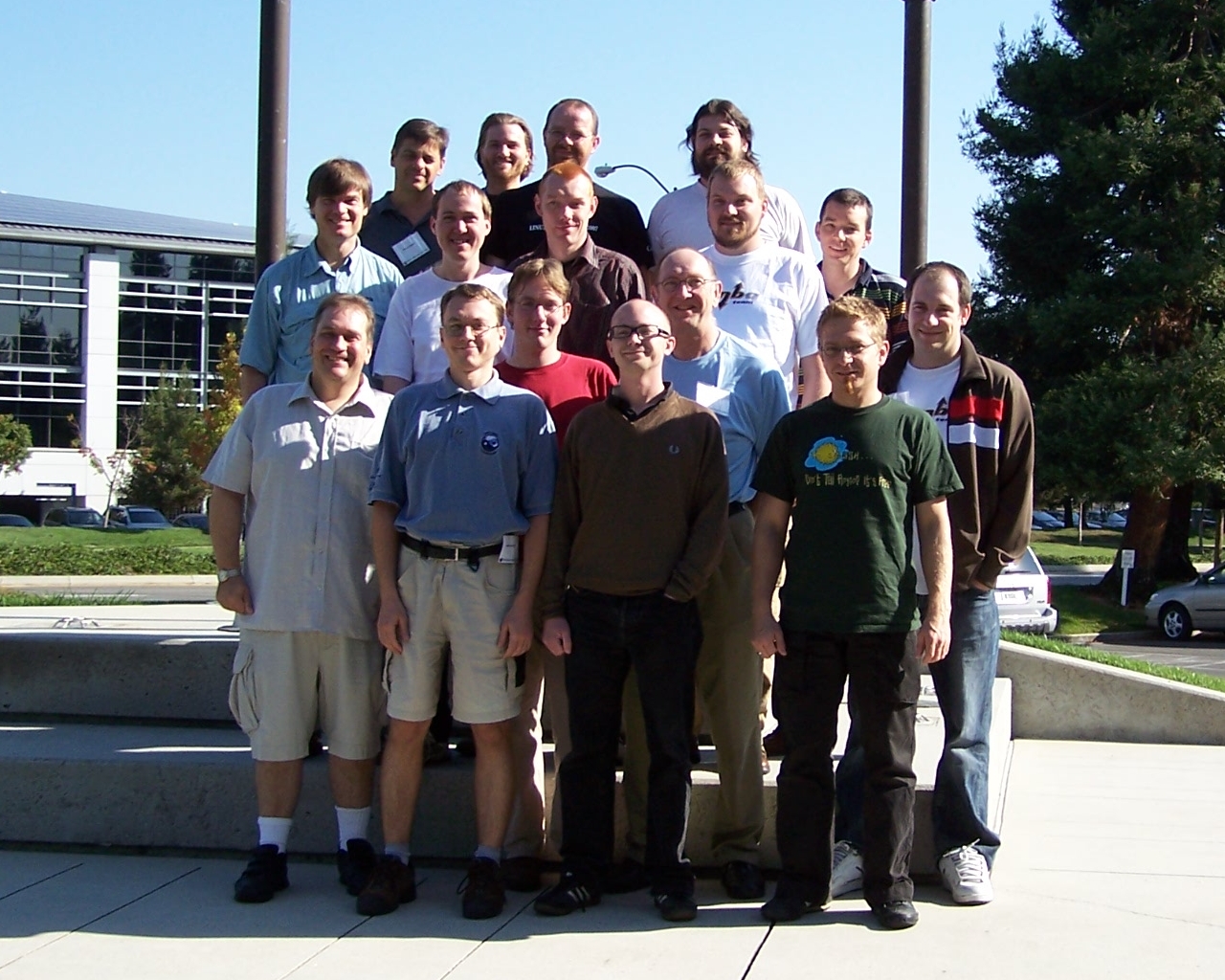
Here's the obligatory group photo, and as you can see we've picked up a few more friends since last year.


You might also want to check out some pre and post summit pics from Bart, Seb and Wolf.

Congratulations once again to all of our students and mentors for another stellar showing in Summer of Code. Keep your eye on the program blog in the coming weeks for notes from the mentor summit and more success stories from our students and mentoring organizations.

(Photo Credit: Robert Kaye)
Read More
Posted in google summer of code, open source | No comments

Thursday, 4 October 2007

Open Source Developers @ Google Speaker Series: Ben Collins-Sussman and Brian Fitzpatrick

Posted on 16:33 by Unknown
By Leslie Hawthorn, Open Source Team

We're pleased to have Ben Collins-Sussman and Brian "Fitz" Fitzpatrick join us once again for the Open Source Developers @ Google Speaker Series. On Thursday, October 25th, Ben and Fitz will cover "What's In It for Me?: How Your Company Can Benefit from Open Sourcing Code." During the evening you'll learn more about various approaches companies use when releasing their software into open source, as well as a bit about the benefits and drawbacks of each method. Plus, you'll get to enjoy the near-legendary repartee between these two Subversion developers.

Like all sessions of the Open Source Developers @ Google Speaker Series, Ben and Fitz's presentation will be open to the public. Doors open at 6:30 PM at our Mountain View campus; guests should plan to sign in at Building 43 reception upon arrival. Refreshments will be served and all are welcome and encouraged to attend. The presentation will also be taped and published along with all of the public Google Tech Talks.

For those of you who were unable to attend our last session, you can watch the video of Michael Still's recent presentation Practical MythTV.
Read More
Posted in mythtv, open source, oss devs, subversion | No comments

Friday, 28 September 2007

Weekly Google Code Roundup: New Gears libraries, fixing mashups, GWT marries the iPhone, and more

Posted on 14:36 by Unknown
By Dion Almaer, Google Developer Programs

It was perfect timing for Doug Crockford, the legendary Ajax curmudgeon, to come to Google to discuss Gears and the mashup problem. The same week that he chatted about the issues that we face, we saw some innovation and fun mashups abound (for example, this Campaign Trails mashup created with the Google Mashup Editor).

Just a few days after we released the ability to do authenticated, cross domain mashups with Google Calendar the JupiterIT folk created Traffik, a mashup that combines your Google Calendar with a Google Map, allowing you to login to view private events and create news ones. It is great to see early experiments with the API such as the Digg Oracle's use of WorkerPool that we went into more detail on.

Vortex is another library that sits on top of Google Gears to add functionality through a nice layer of abstraction. The library will detect if you are online or offline, and have a system to handle one use case for sync issues. Brian Dunnington liked what he saw with the Dojo Offline Toolkit, and took a lot of the ideas from there, giving us a version that isn't coupled to a particular Ajax library. Libraries like this are exactly what we want to see. Gears is aiming to give the community rock solid, low level components, and we expect to see interesting abstractions on top. XMLHttpRequest is to Prototype/Dojo/GWT as Gears it to [insert your cool new offline framework here].

After the GWT 1.4 launch / coming out of beta was announced, Bob Vawter of the GWT team was able to let his hair down and he created a GWT application for the iPhone to see what the experience was like. His take-away was:

The Google Web Toolkit can be used to create applications that, in the same code base, work well on an iPhone and a traditional desktop browser.

You can read more about the development of the GWT Feed Reader.

In other GWT news we interviewed folks from Queplix, an open source CRM company, about their experience building their products which use a lot of GWT, various Google APIs, and even the Google Mini!

Sticking to JavaScript for just a touch more, the Google Maps API team have added a new Local Search Control which makes it simple to search the map that you are on. You can add this control to your Maps mashup with a line of JavaScript.

In other API news, Jeff Scudder announced a new release of the GData Python client library which gives you access to various new releases and a refactored codebase.

What else?

  • T.V. Raman kindly stopped by for a podcast interview on accessibility which may have some data and thoughts that surprise you.
  • The Joomla! team updated us on their Summer of Code experience
  • And, for those of you who write test code, you may recognize the battle cry of: But it works on my machine!. John Thomas talks about the stability of your tests.

As always, check out the latest tech talks, subscribe to the Google Developer Podcast and visit the Google Code YouTube channel.
Read More
Posted in weekly roundup | No comments

Thursday, 27 September 2007

Queplix discusses their GWT open source application

Posted on 09:00 by Unknown
By Dion Almaer, Google Developer Programs

I was recently in New York City and had the chance to meet Steven Yaskin and Paul Tenberg of Queplix, a company that is trying to change the face of CRM using an open source business model. Steven and Paul are both old timers in the CRM industry, and it was very interesting to discuss their vision.

The interview focuses on QueWeb, the open source customer care application that they released. The application is built using GWT and uses a slew of Google APIs and products (such as the Google Mini). We discuss how open source affects their business, how their architected this CRM framework and details on some of the magic that allows you to slurp up legacy applications and hand you back an open source version built with GWT widgets. This enables you to tweak the functionality without being in the proprietary black box. As part of this effort, they created a slew of GWT widgets for reuse. All of this is hosting in their Google Code project.

Watch the full interview below, which ends with a short demo of QueWeb.


Thanks again to Steven and Paul for taking the time to meet.
Read More
Posted in gwt, open source, screencast, video | No comments

Monday, 24 September 2007

Google Developer Podcast Episode Nine: The status of accessibility on the Web

Posted on 12:26 by Unknown
By Dion Almaer, Google Developer Programs

Using iTunes?


T.V. Raman is a Research Scientist at Google who knows a thing or two about accessibility. We took the opportunity to interview him, and Hubbell, his seeing-eye dog (who was nice and quiet).

We started out by asking the honest question that developers ask about accessibility: "What is in it for me?". T.V. discusses the practical issues, and what you should be doing with respect to accessibility, and how it is one piece of the usability picture.

We then delve into the problems of developing accessible websites, and solutions to some of the problems.

If you listen to the interview you will learn:
  • How not to develop in a user-agent specific manner
  • Fun issues with screen readers
  • How audio CAPTCHA brings equality to the pain of CAPTCHA, and how people who can see use the audio ones
  • How painful is the Web to view for a blind person
  • Using the Google Web Transcoder (the other GWT!) to clean up pages
  • How CSS hasn't been as leveraged as much as we would like
  • How the increase in mobile and widget platforms has a side effect of accessible views
  • How RIA applications deal with accessibility
  • How T.V. has written custom clients for Google APIs
  • What standards groups are doing in the accessibility space
  • Dealing with Python, a language that cares about whitespace, as a blind man.
You can download the episode directly, or subscribe to the show (click here for iTunes one-click subscribe).

Also, check out an accessible web search for the visually impaired.
Read More
Posted in accessibility, podcast | No comments
Newer Posts Older Posts Home
Subscribe to: Comments (Atom)

Popular Posts

  • Google Summer of Code & Danish Linux Forum
    Posted by Leslie Hawthorn, Open Source Team The Danish Linux Conference is celebrating its tenth anniversary this year, and the date is com...
  • Weekly Google Code Roundup for July 2-6th
    By Dion Almaer, Google Developer Programs Having the July 4th holiday smack in the middle of the week creates a strange week when it is hard...
  • Weekly Google Code Roundup for June 11-15th
    By Dion Almaer, Google Developer Programs In API and developer-product news... I will start by going meta. Linking to a roundup from a round...
  • Weekly Google Code Roundup for July 16-20th
    By Dion Almaer, Google Developer Programs This week we have the pleasure of having MashupCamp hosted walking distance from the Googleplex. I...
  • Weekly Google Code Roundup for July 23-27th
    By Dion Almaer, Google Developer Programs It has been a busy time for conferences. From MashupCamp last week, to OSCON and The Ajax Experien...
  • Google Gadget Ventures
    By Tom Stocky, Google Developer Programs Good news for Google Gadget developers. We've just launched Google Gadget Ventures , a new pil...
  • Weekly Google Code Roundup for July 8-12th
    By Dion Almaer, Google Developer Programs In API and developer-product news... Othman Laraki talked about the Gears roadmap and development ...
  • Google Developer Day sessions move to San Jose Convention Center
    Posted by Andrew Bowers, Google Developer Programs Thanks to the incredible interest in Google Developer Day, we've moved the session po...
  • Google Sitemaps Launches
    Today, Google launched Google Sitemaps , a new service designed for webmasters that enables them to automatically submit their web pages to ...
  • Google Developer Podcast Episode Four: Mark Limber on Google SketchUp
    By Dion Almaer, Google Developer Programs Using iTunes? We have published the fourth episode of the Google Developer Podcast, which feature...

Categories

  • 20% project
  • 3d
  • accessibility
  • advogato
  • ajax
  • ajax search
  • ajax search books news apis
  • amarok
  • android
  • apache
  • apis
  • apis. charts
  • apple
  • atom publishing protocol
  • axsjax
  • barcodes
  • blogger
  • building ajax apps
  • c++
  • caja
  • calendar
  • camino
  • chronoscope
  • cifs
  • cms
  • collada
  • community
  • conferences
  • cricket
  • cryptography
  • danish linux forum
  • developer
  • django
  • documentation
  • dojo
  • dot net
  • dreamweaver
  • drupal
  • eclipse
  • eclipsecon
  • education
  • email
  • events
  • feeds
  • firevox
  • fosdem
  • freebsd
  • freenet
  • gadgets
  • gcc
  • gdata
  • gdd07
  • geoserver
  • getpaid
  • ghop
  • gnome
  • gnome women's summer outreach program
  • Google
  • google apps for your domain
  • google chart api
  • google checkout
  • google code
  • google code project hosting
  • google code search
  • google data apis
  • google developer day
  • google earth
  • google gadgets
  • google gears
  • google grants
  • google mashup editor
  • google summer of code
  • google web toolkit
  • green linux
  • gsoc
  • gtags
  • guice
  • GWSOP
  • gwt
  • haproxy
  • hibernate
  • howto
  • hpux
  • html
  • html5
  • igoogle
  • image search
  • Imara
  • interviews
  • java
  • javascript
  • joomla
  • joomladayus2007
  • joomladayusa
  • karaoke
  • KDE
  • KDE 4.0
  • kernel
  • kernel summit
  • kml
  • linux
  • linux foundation
  • linux summit
  • linux virtual server
  • linuxconf eu
  • LoCo
  • london
  • mac
  • MacFuse
  • maps
  • meetup
  • MIT CSAIL
  • mobile
  • mylar
  • MySQL
  • mythtv
  • named
  • netbsd
  • nss
  • objective-c
  • OCaml
  • ocr
  • ODF
  • oha
  • OOXML
  • open source
  • openajax alliance
  • opensocial
  • openssl
  • oreilly
  • oscon
  • oscon2007
  • oss devs
  • ossjam
  • osx
  • pactester
  • phone
  • picasa
  • picasa web
  • plone
  • plone sprint
  • podcast
  • portugal
  • programming
  • py3k
  • python
  • python sprint
  • reader
  • research
  • samba
  • scalability
  • screencast
  • security
  • shindig
  • silverstripe
  • sitemaps
  • sixapart
  • sketchup
  • soc
  • solaris
  • spa2007
  • speakers
  • standards
  • student programs
  • subversion
  • summer of code
  • syndication
  • testing
  • themes
  • topp
  • ubucon
  • ubuntu
  • unit test
  • unix
  • video
  • Vim
  • weekly roundup
  • windows
  • windows programming
  • Winter of Code
  • youtube
  • zurich
  • ZXing

Blog Archive

  • ►  2008 (7)
    • ►  January (7)
  • ▼  2007 (159)
    • ▼  December (8)
      • Brian McCallister on Ning, OpenSocial, and Apache ...
      • The Roundup: An offline Shindig that is off the Ch...
      • Our new Developer Community Calendar: View it, Map...
      • Keeping OpenSSL up-to-date
      • Open Source in Zurich with vigor and Vim
      • In just seven days
      • Embed charts in webpages with one of our simplest ...
      • Google Developer Podcast Episode Twelve: Android w...
    • ►  November (13)
      • Google Data Ideathon
      • Google Gadgets going cross-platform
      • Chronoscope: 2 + 2 = 5 with GWT and Android
      • It's here: the Google Highly Open Participation Co...
      • ZXing 1d/2d Barcode decoding source code released
      • Weekly Google Code Roundup: The Androids are openl...
      • Each and every email
      • Introducing AxsJAX -- Access-Enabling AJAX
      • Android SDK, MSM7K kernel patches and blog now ava...
      • nsscache: open source named services system release
      • Google Developer Podcast Episode Eleven: OpenSocia...
      • Can I please have s'mores
      • My How We've Grown
    • ►  October (16)
      • Weekly Google Code Roundup: Leopard day, JavaScrip...
      • Podcast with Bruce Johnson and Joel Webber
      • Google Hosts CIFS Workshop
      • Updates from the I Free Software Forum
      • KDE 4.0 Release Party at Google HQ
      • Blogger GData JavaScript client library released w...
      • An interview with Paul McDonald and Rich Burdon of...
      • Livin' in a Mario World
      • Tell us about the code on your site with Code Sear...
      • Joomla!Day USA East at Google
      • Sigurd Magnusson of SilverStripe on open source an...
      • Weekly Google Code Roundup: Lots of Geo, feeling A...
      • Trip Report: Gears and the Future of Web Apps
      • Google Sponsors Improvements to FreeBSD's Performa...
      • Wrapping up Our Third Summer of Code
      • Open Source Developers @ Google Speaker Series: Be...
    • ►  September (11)
      • Weekly Google Code Roundup: New Gears libraries, f...
      • Queplix discusses their GWT open source application
      • Google Developer Podcast Episode Nine: The status ...
    • ►  August (16)
    • ►  July (11)
    • ►  June (14)
    • ►  May (13)
    • ►  April (12)
    • ►  March (19)
    • ►  February (14)
    • ►  January (12)
  • ►  2006 (98)
    • ►  December (10)
    • ►  November (14)
    • ►  October (13)
    • ►  September (11)
    • ►  August (14)
    • ►  July (9)
    • ►  June (5)
    • ►  May (5)
    • ►  April (6)
    • ►  March (4)
    • ►  February (2)
    • ►  January (5)
  • ►  2005 (40)
    • ►  December (4)
    • ►  November (1)
    • ►  October (3)
    • ►  September (2)
    • ►  August (5)
    • ►  July (3)
    • ►  June (11)
    • ►  May (2)
    • ►  April (4)
    • ►  March (5)
Powered by Blogger.

About Me

Unknown
View my complete profile