Online Server Support

  • Subscribe to our RSS feed.
  • Twitter
  • StumbleUpon
  • Reddit
  • Facebook
  • Digg
Showing posts with label open source. Show all posts

Wednesday, 23 January 2008

KDE 4.0 Release Event wrap-up

Posted on 21:32 by Unknown
By Erica Baker, Open Source Team

I had the pleasure of helping out with the KDE 4.0 Release Event this past weekend. With attendees of all ages and backgrounds from around the world, the event was a huge success. In addition to a great coming out party for KDE 4.0, it was also the venue in which Trolltech announced it would adopt GPL 3 for Qt.

Thursday was 'un-conference' style with attendees organizing impromptu BOFs and breakout sessions. However, a lot of people spent a good portion of the day discovering who else was there, as many of the KDE developers and community members were meeting each other for the first time.

Friday was the big day with around 150 people and 2 dragons in attendance. Aaron Seigo's keynote was well received by KDE release parties going on simultaneously around the world, thanks to the video streaming magic of Franz Keferböck. Many other speakers graced the podium after Aaron, including the two Release Event Contest winners, Kyle Cunningham and Aron Stansvik. The day finished with cocktails and a special vintage provided by Celeste.

Things wrapped up on Saturday with a few more BOFs. Since we had all that A/V goodness going unused, many attendees took it upon themselves to give a presentation or two. The most popular one was the Amarok 2 talk given by Jeff Mitchell and Leo Franchi (both worked on Amarok as Google Summer of Code students).

All in all, everyone seemed to have a great time. Many thanks go to my co-conspirators Tiffany and Cat from the Open Source Team, and to Wade, Franz, Sebas, Troy and Jeff of KDE for their efforts in putting the event together. I hear that a similar event is in the works for next year. Here's hoping Aaron Seigo does karaoke at that one too.
Read More
Posted in amarok, karaoke, KDE 4.0, open source, summer of code | No comments

Monday, 10 December 2007

Keeping OpenSSL up-to-date

Posted on 18:12 by Unknown
By Steve Marquess, Open Source Software Institute

OpenSSL is perhaps the most widely used of all cryptographic libraries, both in the open source world and by commercial enterprises. The OpenSSL team is often approached by such enterprises seeking assistance with specific problems or features of particular interest to that enterprise. Less often they are approached by a sponsor with a technical need and the vision to address that need in a way that benefits the open source community as a whole.

OSSI has had a long association with OpenSSL, beginning with work over a five year period on the groundbreaking FIPS 140-2 validation of an OpenSSL derived crypto library (implemented largely by Googler Ben Laurie) and continuing with additional validations currently underway with extensive improvements by Dr. Stephen Henson and others. We were pleased to help facilitate Google's sponsorship of RFC4507 support to OpenSSL.

RFC 4507, also known as “stateless session resumption,” is a relatively new draft standard for a mechanism that enables a secure web (TLS) server to resume sessions without explicitly preserving per-client session state. The TLS server encapsulates the session state into a ticket that is preserved in encrypted form and subsequently provided to a client. That client can then resume the previous session using the information in that ticket, avoiding the need for the full TLS negotiation.

This mechanism may be used with any TLS ciphersuite. It makes use of TLS extensions defined in RFC4366 and defines a new TLS message type.

Stateless session resumption is of particular value in the following situations:

  1. For servers that handle a large volume of transactions from many users

  2. For servers that must cache sessions for a long time

  3. For load balancing requests across servers

  4. For embedded servers with little memory


As an added bonus, RFC4366 support includes the Server Name Indication extension, which allows browsers to specify a server name when connecting to an SSL host. This means that SSL hosts can finally use name-based virtual hosting instead of burning an IP address per host.

The implementation in OpenSSL and the interoperability testing were performed by Steve Henson. This support is available in both the current 0.9.8 product branch and in the development trunk (0.9.9).
Read More
Posted in cryptography, open source, openssl, security | No comments

Friday, 7 December 2007

Open Source in Zurich with vigor and Vim

Posted on 10:25 by Unknown
By Leslie Hawthorn, Open Source Team

Looking for a cool place to hack with like-minded colleagues? Going to be in or around Zurich on December 13th? If so, please join us for our inaugural Open Source Jam held at Google Switzerland. We'll provide the hacking lounge, Wi-Fi, pizza, beer and the creator of the Vim text editor, Bram Moolenaar. You supply your laptop, good ideas and community spirit.

You can find full details and information on how to register in our Open Source Jam Zurich Google Group. If you haven't already done so, please join the group and let us know your thoughts. And if you happen to attend the event, post a comment and let us know how it went.
Read More
Posted in open source, ossjam, Vim, zurich | No comments

Thursday, 6 December 2007

In just seven days

Posted on 17:00 by Unknown
By Leslie Hawthorn, Open Source Team

We announced the Google Highly Open Participation Contest a little over a week ago, and the response has been phenomenal. We already have over 350 student contributors, and the participating organizations have let us know that they're overwhelmed by all the great contributions they've received from their contestants. We're delighted to bring you this video status update, with an extra treat: Guido van Rossum, the creator of Python, stopped in to tell us a little bit more about the Python Software Foundation's participation in the contest.


We always love to hear from you, so feel free to contribute some task ideas and join the contest discussion list.
Read More
Posted in ghop, open source | No comments

Tuesday, 27 November 2007

It's here: the Google Highly Open Participation Contest

Posted on 19:10 by Unknown
By Leslie Hawthorn, Open Source Team

The Google Summer of Code program has been a joint labor of love between Google and the open source community for the past three years, and the results have been spectacular: hundreds of college students have been introduced to open source software, thousands of people across the globe have begun development together and millions of lines of open code have been produced, 4 million last year alone. We've been particularly proud of this program and how much it has helped the community and we've spent a lot of time thinking about ways we can continue helping open source projects find even more contributors. Today, we're pleased to announce the Google Highly Open Participation Contest, our new effort to get pre-university students involved in all aspects of open source development, from fixing bugs to writing documentation and doing user experience research.

While we're very excited about many aspects of the contest, the best part is that everyone can participate. Contestants must meet the eligibility requirements, but anyone interested in helping out can simply suggest a task to be included in the contest. Our contestants have a chance to win t-shirts, cash prizes, and a visit the Googleplex for a day of technical talks, delicious food and a photo with our very own Stan T. Rex.

Want to learn more? Check out the contest FAQs and tell your favorite pre-college students to pick a task or two to complete. You can always visit our discussion group to get help or share your thoughts.

Update: Fixed the broken links.
Read More
Posted in ghop, google summer of code, open source, soc, student programs | No comments

ZXing 1d/2d Barcode decoding source code released

Posted on 11:34 by Unknown
By Sean Owen, Google Print Ads Team

Recently in the New York Times, we placed a small graphic as part of a Google Print Ad. You aren't looking at one of those eye focus games (It's a sailboat! Or a shark!) but a two-dimensional barcode. Those of us who already know what it is pulled out our phones and "clicked" it with the camera, and were connected to the advertiser's web site. "Wha?", you say? See http://www.google.com/printads/barcode. While this kind of thing has been a common sight in Asia for years, this ad is one of many signs that the technology is arriving in Europe and North America.

But Advertising is only part of the story here. Engineering is also involved and we want to improve the quality and availability of barcode reader software available to developers and end users. So today I would like to announce the "ZXing" (from: "zebra crossing") project, an open-source, Java, multi-format 1D/2D barcode reader which can be built into a reader application for Java and Java ME -- and later, Android.

This project began as a 20% project and is not yet complete, so opening it up is a bit of an experiment. It's not yet the Best Barcode Reader Ever, but it's looking pretty good. For now we want to find those those who can make use of and help improve what's here, so that those good ideas are shared to all developers and everybody wins.

Developers can find the ZXing project on Google Code, and we hope you'll join us on our Google Group and tell us about what you like and don't like about the code.
Read More
Posted in 20% project, barcodes, google code project hosting, open source, ZXing | No comments

Tuesday, 13 November 2007

Introducing AxsJAX -- Access-Enabling AJAX

Posted on 10:14 by Unknown
Posted by Charles L. Chen and T.V Raman

As the developer behind Fire Vox I've always wanted to make AJAX web applications truly usable for the blind and visually impaired. The challenge is that these users have to deal with a much higher learning curve than sighted users. Instead of simply learning the controls for a web application, they have to also learn how to get their assistive technology of choice to go to the interesting parts of that application to find out what is currently there.

When I started as a Noogler, I was extraordinarily impressed with the tools that T.V. Raman had built into Emacspeak for efficiently performing specific tasks. An insight that I gained from watching him use Emacspeak is that the application should just say the right thing in response to user actions; users should not have to do an action in the application and then use their assistive technology to go hunting around the screen to figure out what happened.

In my first week at Google, I discovered Google Reader a highly optimized feed reader with very good keyboard support. For my starter project at Google, I decided to access-enable this application using W3C ARIA. Using Greasemonkey, I could inject JavaScript code to add the needed ARIA bits to make Google Reader say the right things at the right time.

Connecting The Dots

Based on the experience of access-enabling Reader, we have now refactored the code to come up with a common JavaScript framework for enhancing the accessibility of AJAX applications. This framework is called AxsJAX, and it was refined in the process of access-enabling Web Search.

We're now excited to open-source this framework since we believe that there is nothing Google-specific in the techniques we have implemented. We invite the Web developer community to help us collectively define a robust framework for rapid prototyping of accessibility enhancements to Web 2.0 applications.

The ability to rapidly prototype end-user interaction has led to an explosion in the number of AJAX applications; until now, visually impaired users have been left behind in this process. We hope that the AxsJAX framework encourages the Web community to bring the power of Web 2.0 development to solving the problem of accessing rich Web interaction in an eyes-free environment.
Read More
Posted in accessibility, ajax, axsjax, firevox, open source, reader | No comments

Monday, 5 November 2007

nsscache: open source named services system release

Posted on 23:14 by Unknown
By Jamie Wilkinson and V Hoffman, Systems Administrators

Remember remember the fifth of november, especially if you have to manage unix Named Services (NSS) on a lot of workstations! We're releasing a small python utility, called nsscache, that is used to cache remote NSS maps locally on a given host. Combined with cron, it provides a simple and effective way to remove a critical network dependency from your hosts and potentially speed things up a bit.

You'd be surprised how upset a system can get with a slow, unresponsive, or missing NSS.

This initial release supports pulling passwd, shadow, and group maps from an RFC 2307 LDAP schema and storing them in either nssdb or flat text files. In a wee bit, we'll also release support for netgroup and automount maps as well. The utility is fairly plug and play; our hope is that folks who use it with other data sources (sql databases, soap, etc) and possibly other data stores will extend our codebase and share their extensions with the rest of the open source community.

Why you may be interested?

As soon as you have more than one machine in your network, you want to share usernames between those systems. Linux administrators have been brought up on the convention of LDAP or NIS as a directory service, and /etc/nsswitch.conf, nss_ldap.so, and nscd to manage their nameservice lookups.

Even small networks will have experienced intermittent name lookup failures, such as a mail receiver sometimes returning "User not found" on a mailbox destination because of a slow socket over a congested network, or erratic cache behaviour by nscd. To combat this problem, we have separated the network from the NSS lookup codepath, instead using an asynchronous cron job and a glorified script, improving the speed and reliability of NSS lookups.

We'll be giving a small presentation about our motivations and experiences at the upcoming linux.conf.au event in Melbourne Australia, if you happen to be down under in February!
Read More
Posted in named, nss, open source, unix | No comments

Wednesday, 24 October 2007

Google Hosts CIFS Workshop

Posted on 16:15 by Unknown
By Jeremy Allison, Open Source Team and Samba Core Developer

Around sixty developers from over twenty different companies converged on Google's Mountain View Campus at the end of September to sample the free food. Oh yes, and also to test their implementations of the CIFS network protocol for interoperability.

CIFS, the Common Internet File System (that's Windows Networking to you and me), is the file sharing protocol build into all Windows versions, and also MacOS X, Linux, HPUX and now Solaris clients. Samba is the best known Free Software implementation of CIFS, and most of the Samba Team were there to help improve Samba3 and Samba4's interoperability along with the other CIFS vendors.

Over the three days much code was written, much beer was drunk, and the air was turned blue with cursing when bugs were found! As the Samba Team were mentoring several Google Summer of CodeTM students, we also got to record a podcast about our experiences participating in the program over the past three years.

Thanks to Google for hosting the event and setting up the gigabit networking required. The endless coffee supply was also essential when dealing with network protocol problems.

The best summary of the success of our testing occurred on the final day of the event, when a sad and frustrated CIFS client programmer wrote the following on our testing notes whiteboard:

"the server *hates* me :-) :-)"

It was great to see everyone coming together, even people from competing companies, to help fix problems with everyone's implementations of CIFS. Look for the resulting improvements in new versions of products and future releases of Samba.


The Samba Team takes a break during the CIFS Workshop.

(Photo Credit: Leslie Hawthorn)
Read More
Posted in cifs, hpux, linux, open source, osx, podcast, samba, solaris | No comments

Tuesday, 23 October 2007

Updates from the I Free Software Forum

Posted on 16:43 by Unknown
Post by Fernanda Weiden, Systems Administration Team

I recently traveled to the I Free Software Forum in Lisbon, Portugal, where I gave two talks. The first was on load balancing and the second focused on "Google e o Software Livre" (Google and Free Software). The main organizer of the conference was Ralf Braga, an old friend of mine from Brazil, who moved to Lisbon few months ago.

Both of the talks were well attended, which was great. During my load balancing talk, I covered things I found out while testing Linux Virtual Server and HAProxy, two open source software load balancing solutions. I explained a bit about the basics of load balancing, and then the pros and cons of each approach.

Lisbon is a very beautiful city. Everyone was chatting about the amazing growth of conferences about "Software Livre" in that country. There will be a total of 6 conferences about open source software around Portugal in just the next few months.

There were around of 200 people attending two simultaneous rooms of talks over two days, and most attendees were university students. One of the sponsors prepared the table for their booth in the same shape as the Ubuntu logo. Really cool. They also had Ubuntu pillows. Do we have Google Code pillows? We should. :)

The organizers are planning the second edition of the conference for next year already. I proposed to the participants that each one of them brings at least one friend who has never been to an free software conference before with them when they return. I know I'm already looking forward to going in 2008!

(The I Free Software Forum site is in Portugese. You can read an English translation.)
Read More
Posted in google code, haproxy, linux virtual server, open source, portugal, ubuntu | No comments

KDE 4.0 Release Party at Google HQ

Posted on 15:11 by Unknown
By Leslie Hawthorn, Open Source Team

When we met Sebas at the Ubuntu Developer Summit last November, he thought the digs were pretty cool and he asked if Google would be willing to host a release party for KDE's upcoming 4.0 launch. Since Sebas seemed like such a nice chap and we love hosting open sourcerers, we said "Hey, why not?"

While the KDE development team has been hard at work preparing Betas, we've been collaborating with the project's outreach team on details for the release party. The release party, along with typical conference activities like presentations and BoFs, will be rockin' at Google Corporate Headquarters January 17-19, 2008.

If you're looking for more information on the event, check out Troy Unrau's blog. Rumor has it that that KDE e.V., the non-profit organization behind the KDE project, will even fly one lucky KDE community member out for the release party.

We hope to see you there!
Read More
Posted in KDE, KDE 4.0, open source | No comments

Monday, 15 October 2007

Sigurd Magnusson of SilverStripe on open source and the Summer of Code

Posted on 14:47 by Unknown
By Dion Almaer, Google Developer Programs

Sigurd Magnusson, co-founder of the SilverStripe open source CMS platform, was in town for the mentor summit that wrapped up the Summer of Code.

We used that opportunity to grab him, put him in a Tiki hut, and chat with him about SilverStripe. We discuss life as an open source company, and the experience and advice based on having ten students enrolled in the summer of code program.

Thanks to Ohloh we have statistics on the code produced by the students. Obviously, the lines of code metric is purely quantitative and doesn't show the actual work involved, but it is great to see how these students have produced:


In the chat below you will hear about some of the really cool additions that SilverStripe has in its trunk thanks to the students.

Read More
Posted in google summer of code, interviews, open source, silverstripe, video | No comments

Friday, 12 October 2007

Google Sponsors Improvements to FreeBSD's Performance Measurement Toolkit

Posted on 08:57 by Unknown
By Murray Stokely, Software Engineer and FreeBSD Committer

Most CPUs today have built in performance measurement counters (PMCs) that can measure interesting low-level hardware events such as cache misses, branch mispredicts, and tlb misses. FreeBSD's HWPMC(4) driver "virtualizes" these hardware counters, allowing multiple processes to use them, and for multiple hardware counters to be concurrently active. Both simple counting and sampling (profiling) are supported, along with multi-CPU operation. FreeBSD's performance measurement toolset, PmcTools, is built using HWPMC.

PmcTools helps answer the following broad questions:
  • What is the system doing at this point of time? (e.g. "What hardware events are being seen in unusual numbers?")
  • Which part of the system are the symptoms associated with? (e.g. "Which are the 'hot' locations in the source?")

Recently, Google sponsored the development of an oft requested enhancement to FreeBSD's PmcTools: that of capturing the call chains leading to "hot" locations in the code. Call chains provide additional insight into the behavior of the system; in addition to determining the "hot" locations in the code, developers gain insight into why these locations became "hot" in the first place.

HWPMC and associated userland tools have been invaluable to the FreeBSD community in improving the scalability and performance of the upcoming FreeBSD 7 release. Kris Kennaway of the FreeBSD Project notes that "hwpmc is one of our most powerful tools for measuring and understanding CPU performance on FreeBSD. Support for profiling of call graphs was an important missing piece that will simplify the ability of developers to analyze performance bottlenecks in the kernel and in application code". Kip Macy notes that hwpmc has been invaluable in his 10 Gigabit Ethernet tuning efforts, and Arun Sharma notes that this work was particularly successful because it was quickly merged and is available out of the box to users of FreeBSD.

Check out this latest and greatest addition to PmcTools and let the FreeBSD community know what you think!
Read More
Posted in freebsd, open source | No comments

Wednesday, 10 October 2007

Wrapping up Our Third Summer of Code

Posted on 15:32 by Unknown
By Leslie Hawthorn, Open Source Team

We just wrapped up our third Summer of Code, and as with 2006 we invited mentors from all successful organizations to Google for our annual Mentor Summit. We spent all day Saturday with our colleagues from the open source community sharing knowledge to improve Summer of Code, fostering collaboration and, of course, having fun! Our attendees proposed and led sessions, unconference style, from "How Do You Transfer an Itch?" to "The Stick, the Carrot and Sushi." Marty once again treated everyone to a day of free association and tinker toys in Casablanca.

Here's the obligatory group photo, and as you can see we've picked up a few more friends since last year.


You might also want to check out some pre and post summit pics from Bart, Seb and Wolf.

Congratulations once again to all of our students and mentors for another stellar showing in Summer of Code. Keep your eye on the program blog in the coming weeks for notes from the mentor summit and more success stories from our students and mentoring organizations.

(Photo Credit: Robert Kaye)
Read More
Posted in google summer of code, open source | No comments

Thursday, 4 October 2007

Open Source Developers @ Google Speaker Series: Ben Collins-Sussman and Brian Fitzpatrick

Posted on 16:33 by Unknown
By Leslie Hawthorn, Open Source Team

We're pleased to have Ben Collins-Sussman and Brian "Fitz" Fitzpatrick join us once again for the Open Source Developers @ Google Speaker Series. On Thursday, October 25th, Ben and Fitz will cover "What's In It for Me?: How Your Company Can Benefit from Open Sourcing Code." During the evening you'll learn more about various approaches companies use when releasing their software into open source, as well as a bit about the benefits and drawbacks of each method. Plus, you'll get to enjoy the near-legendary repartee between these two Subversion developers.

Like all sessions of the Open Source Developers @ Google Speaker Series, Ben and Fitz's presentation will be open to the public. Doors open at 6:30 PM at our Mountain View campus; guests should plan to sign in at Building 43 reception upon arrival. Refreshments will be served and all are welcome and encouraged to attend. The presentation will also be taped and published along with all of the public Google Tech Talks.

For those of you who were unable to attend our last session, you can watch the video of Michael Still's recent presentation Practical MythTV.
Read More
Posted in mythtv, open source, oss devs, subversion | No comments

Thursday, 27 September 2007

Queplix discusses their GWT open source application

Posted on 09:00 by Unknown
By Dion Almaer, Google Developer Programs

I was recently in New York City and had the chance to meet Steven Yaskin and Paul Tenberg of Queplix, a company that is trying to change the face of CRM using an open source business model. Steven and Paul are both old timers in the CRM industry, and it was very interesting to discuss their vision.

The interview focuses on QueWeb, the open source customer care application that they released. The application is built using GWT and uses a slew of Google APIs and products (such as the Google Mini). We discuss how open source affects their business, how their architected this CRM framework and details on some of the magic that allows you to slurp up legacy applications and hand you back an open source version built with GWT widgets. This enables you to tweak the functionality without being in the proprietary black box. As part of this effort, they created a slew of GWT widgets for reuse. All of this is hosting in their Google Code project.

Watch the full interview below, which ends with a short demo of QueWeb.


Thanks again to Steven and Paul for taking the time to meet.
Read More
Posted in gwt, open source, screencast, video | No comments

Wednesday, 19 September 2007

Updates from the Django Sprint

Posted on 10:42 by Unknown
by Adrian Holovaty, Django core developer

More than 200 people around the world devoted their time and brainpower to improving the Django Web framework this weekend, during a scheduled Django coding sprint. On Friday, September 14th, the first day of the sprint, some Django developers gathered at Google's offices in Chicago and Mountain View for the benefits of in-person communication, camaraderie and, yes, free food.

17 people showed up at Google Chicago, which was a sort of ground zero for the sprint, with the project's BDFLs Adrian Holovaty and Jacob Kaplan-Moss in attendance. Another 7 people participated from Google's Mountain View office, which was linked with Chicago via videoconference.

Python creator (and Google employee) Guido van Rossum even stopped by via videoconference to give a pep talk about Django version 1.0 and share some of his experience running a large open-source project.

The sprint was intensely productive, with more than 400 tickets closed in the Django issue-tracking system, 300 new patches/ticket attachments and more than 200 commits to the Django code base. All told, there were more than 2,440 changes, including wiki changes, ticket changes, patch uploads and code check-ins.

Overall, the consensus was: "We should do this more often!"


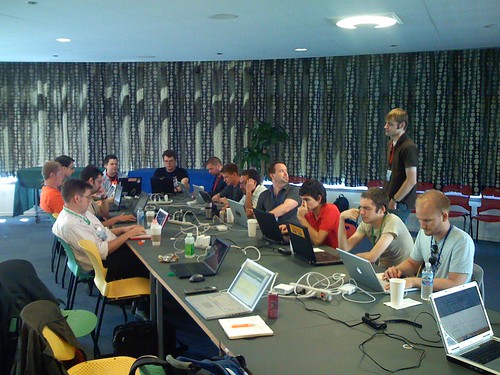
The Chicago sprinters, hard at work (photo by Jacob Kaplan-Moss)
Read More
Posted in django, open source, python | No comments

Friday, 14 September 2007

Linux Kernel-Userland Interface Design, Testing, and Documentation: An Update from LinuxConf EU, and the 2007 Linux Kernel Summit

Posted on 11:42 by Unknown
By Michael Kerrisk, Software Engineering Team

As you may know,Google allows its engineers to spend 20% of their time on projects independent of their regular day to day job. For my 20% time, I chose to continue and expand my work on maintaining the Linux man-pages.

Since April, we've managed to ship 21 new releases, with a dozen or so new pages, and around 400 major and minor improvements to existing pages.

My work on the Linux Man-pages project man-pages led me to talk about kernel-userland interface design, testing, and documentation at the recent LinuxConf Europe, where my Zurich colleague Roman Marxer also spoke about Google's recently open-sourced Ganeti virtual server management software.

I was lucky enough to be invited to the immediately following USENIX Linux Kernel Developers Summit, where I joined Google colleagues Andrew Morton, Paul Menage, and Martin Bligh to participate in the discussion of current topics related to kernel development, including the topic of kernel-userland API design, testing, and documentation.

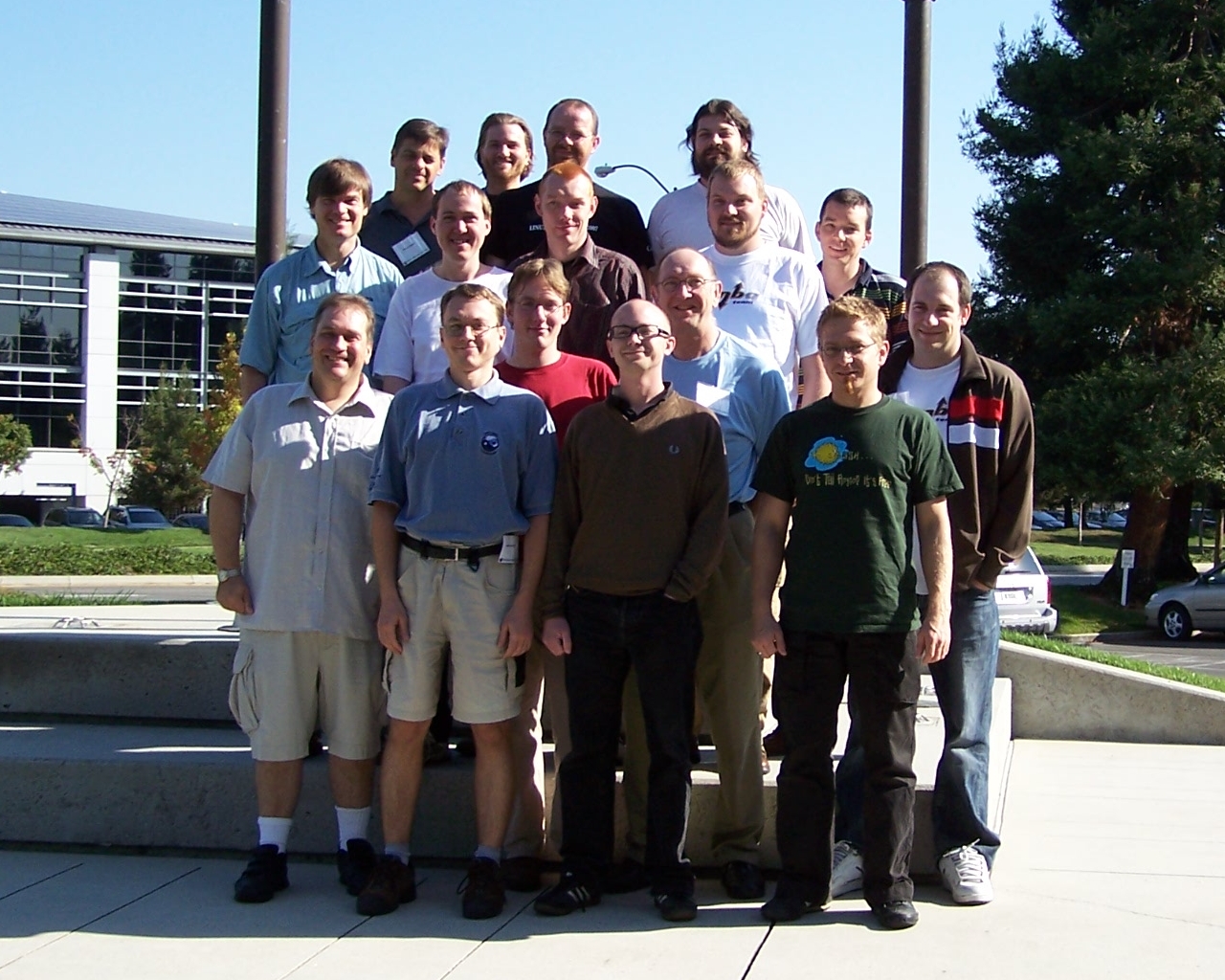
You can read my talk, and in-depth coverage of the Kernel Developer Summit at LWN.net. It's available to LWN.net subscribers only until the 20th of September, but you can already see the obligatory group photo.


Googlers Andrew Morton and Paul Menage relaxing at the end of the Linux Kernel Summit, Cambridge, England

(photo credit: Michael Kerrisk)

Ed. note: Post updated to fix typo.
Read More
Posted in 20% project, documentation, kernel summit, linux, linuxconf eu, open source | No comments

Google welcomes ISO decision on OOXML

Posted on 09:27 by Unknown
By Zaheda Bhorat, Open Source Team

Google welcomes the ISO decision to not approve the fast track of Office Open XML (OOXML) proposed standard DIS 29500 (ECMA 376).

Our engineers conducted an independent analysis of the OOXML specification and found several areas of concern, which we communicated both to the ISO and to the public. These include and are not limited to the following:
  • for a specification of this size it was not given enough time for review;
  • the undocumented features of OOXML prevents its implementation by other vendors;
  • dependencies on other Microsoft proprietary formats and their technical defects makes it difficult to fully implement; and
  • the overall cost for vendors of implementing multiple standards (hence the lack of OOXML implementations in the marketplace).
It is also incompatible with the existing ISO standard ISO 26300:2006, the Open Document Format (ODF), which already offers a high degree of interoperability, wide support, and offers the level playing field the world needs. Google is a supporter of ODF and has successfully integrated this open format into Google Docs and Spreadsheets. ODF also enjoys implementation in over twelve other products.

The ISO approval required at least 2/3 (i.e., 66.66%) of the votes cast by participating (P) members to be positive, and no more than 1/4 (i.e., 25%) of the total number of national body votes cast negative. Neither of these criteria were met by the proposed standard.

The concerns from many technical experts around the world were submitted as comments by the voting bodies to ISO on September 2, 2007. These must now be resolved at a Ballot Resolution Meeting (BRM) on February 25-29, 2008. In contrast, ODF was approved unanimously (23-0 among P members, 31-0 overall) as an international standard by ISO in May 2006.

As we represented our position in many countries, we were encouraged by the process observed in some places that truly evaluated the proposed standard on its technical merits as well as the feasibility of implementing the standard for the people of the country. These countries successfully declined or abstained due to insufficient information about the standard or the lack of time to evaluate the specification. In addition, many irregularities have been reported in the voting process (see here, here and here).

Technical standards should be arrived at transparently, openly, and based on technical merit. Google is committed to helping the standards community remain true to this ideal and maintain their independence from any commercial pressure.

Google supports one open document format and calls on industry participants to collaboratively work on ODF. With multiple implementations of one open standard for documents, users, businesses and governments around the world can have both choice and freedom to access their own documents, share with others and pass onto future generations.
Read More
Posted in ODF, OOXML, open source, standards | No comments

Thursday, 30 August 2007

Ganeti: Open source virtual server management software released

Posted on 12:13 by Unknown
By Roman Marxer, Ganeti team

Today we're happy to announce the first beta release of Ganeti, an open source virtual server management software built on top of Xen and other open source software.

Ganeti started as a small project in Google's Zurich office. We've been using it internally for a while, and now we're excited to share it more broadly under GPLv2.

Here at Google, we've used Ganeti in the internal corporate environment to facilitate cluster management of virtual servers in commodity hardware, increasing the efficiency of hardware usage and saving space, power and cooling. Ganeti also provides fast and simple recovery after physical failures.

Feel free to download it from http://code.google.com/p/ganeti and don't hesitate to give us feedback.

Cheers,

Ganeti Team
Read More
Posted in open source | No comments
Older Posts Home
Subscribe to: Posts (Atom)

Popular Posts

  • Weekly Google Code Roundup for July 2-6th
    By Dion Almaer, Google Developer Programs Having the July 4th holiday smack in the middle of the week creates a strange week when it is hard...
  • Weekly Google Code Roundup for July 16-20th
    By Dion Almaer, Google Developer Programs This week we have the pleasure of having MashupCamp hosted walking distance from the Googleplex. I...
  • Weekly Google Code Roundup for July 23-27th
    By Dion Almaer, Google Developer Programs It has been a busy time for conferences. From MashupCamp last week, to OSCON and The Ajax Experien...
  • Weekly Google Code Roundup for July 8-12th
    By Dion Almaer, Google Developer Programs In API and developer-product news... Othman Laraki talked about the Gears roadmap and development ...
  • Weekly Google Code Roundup for June 11-15th
    By Dion Almaer, Google Developer Programs In API and developer-product news... I will start by going meta. Linking to a roundup from a round...
  • Google Gadget Ventures
    By Tom Stocky, Google Developer Programs Good news for Google Gadget developers. We've just launched Google Gadget Ventures , a new pil...
  • Google Developer Day sessions move to San Jose Convention Center
    Posted by Andrew Bowers, Google Developer Programs Thanks to the incredible interest in Google Developer Day, we've moved the session po...
  • Google Releases Maps API for External Use
    I'm very happy to let you know that our friends who have created Google Maps have released an API so that you can post interactive, dra...
  • Weekly Google Code Roundup for June 25-29th
    By Dion Almaer, Google Developer Programs It has been a great week. From the new Google Gadget Ventures, to the new ability to click and dra...
  • Google Developer Podcast Episode Three: Mike Tsao on Google Gears
    By Dion Almaer, Google Developer Programs Using iTunes? We have published the third episode of the Google Developer Podcast, which delves ...

Categories

  • 20% project
  • 3d
  • accessibility
  • advogato
  • ajax
  • ajax search
  • ajax search books news apis
  • amarok
  • android
  • apache
  • apis
  • apis. charts
  • apple
  • atom publishing protocol
  • axsjax
  • barcodes
  • blogger
  • building ajax apps
  • c++
  • caja
  • calendar
  • camino
  • chronoscope
  • cifs
  • cms
  • collada
  • community
  • conferences
  • cricket
  • cryptography
  • danish linux forum
  • developer
  • django
  • documentation
  • dojo
  • dot net
  • dreamweaver
  • drupal
  • eclipse
  • eclipsecon
  • education
  • email
  • events
  • feeds
  • firevox
  • fosdem
  • freebsd
  • freenet
  • gadgets
  • gcc
  • gdata
  • gdd07
  • geoserver
  • getpaid
  • ghop
  • gnome
  • gnome women's summer outreach program
  • Google
  • google apps for your domain
  • google chart api
  • google checkout
  • google code
  • google code project hosting
  • google code search
  • google data apis
  • google developer day
  • google earth
  • google gadgets
  • google gears
  • google grants
  • google mashup editor
  • google summer of code
  • google web toolkit
  • green linux
  • gsoc
  • gtags
  • guice
  • GWSOP
  • gwt
  • haproxy
  • hibernate
  • howto
  • hpux
  • html
  • html5
  • igoogle
  • image search
  • Imara
  • interviews
  • java
  • javascript
  • joomla
  • joomladayus2007
  • joomladayusa
  • karaoke
  • KDE
  • KDE 4.0
  • kernel
  • kernel summit
  • kml
  • linux
  • linux foundation
  • linux summit
  • linux virtual server
  • linuxconf eu
  • LoCo
  • london
  • mac
  • MacFuse
  • maps
  • meetup
  • MIT CSAIL
  • mobile
  • mylar
  • MySQL
  • mythtv
  • named
  • netbsd
  • nss
  • objective-c
  • OCaml
  • ocr
  • ODF
  • oha
  • OOXML
  • open source
  • openajax alliance
  • opensocial
  • openssl
  • oreilly
  • oscon
  • oscon2007
  • oss devs
  • ossjam
  • osx
  • pactester
  • phone
  • picasa
  • picasa web
  • plone
  • plone sprint
  • podcast
  • portugal
  • programming
  • py3k
  • python
  • python sprint
  • reader
  • research
  • samba
  • scalability
  • screencast
  • security
  • shindig
  • silverstripe
  • sitemaps
  • sixapart
  • sketchup
  • soc
  • solaris
  • spa2007
  • speakers
  • standards
  • student programs
  • subversion
  • summer of code
  • syndication
  • testing
  • themes
  • topp
  • ubucon
  • ubuntu
  • unit test
  • unix
  • video
  • Vim
  • weekly roundup
  • windows
  • windows programming
  • Winter of Code
  • youtube
  • zurich
  • ZXing

Blog Archive

  • ▼  2008 (7)
    • ▼  January (7)
      • KDE 4.0 Release Event wrap-up
      • iGoogle Themes API
      • Wednesday in San Francisco: OpenSocial Hackathon a...
      • An OpenSocial HappyHour party with Gears
      • ChartMaker: A tool for the Google Chart API
      • Google Developer Courses on YouTube
      • Thanks to you
  • ►  2007 (159)
    • ►  December (8)
    • ►  November (13)
    • ►  October (16)
    • ►  September (11)
    • ►  August (16)
    • ►  July (11)
    • ►  June (14)
    • ►  May (13)
    • ►  April (12)
    • ►  March (19)
    • ►  February (14)
    • ►  January (12)
  • ►  2006 (98)
    • ►  December (10)
    • ►  November (14)
    • ►  October (13)
    • ►  September (11)
    • ►  August (14)
    • ►  July (9)
    • ►  June (5)
    • ►  May (5)
    • ►  April (6)
    • ►  March (4)
    • ►  February (2)
    • ►  January (5)
  • ►  2005 (40)
    • ►  December (4)
    • ►  November (1)
    • ►  October (3)
    • ►  September (2)
    • ►  August (5)
    • ►  July (3)
    • ►  June (11)
    • ►  May (2)
    • ►  April (4)
    • ►  March (5)
Powered by Blogger.

About Me

Unknown
View my complete profile